Gransnet forums

Estrangement

It's official: Grandparents are good for children

(142 Posts)
DogWhisperer Thu 04-Jun-26 11:47:29

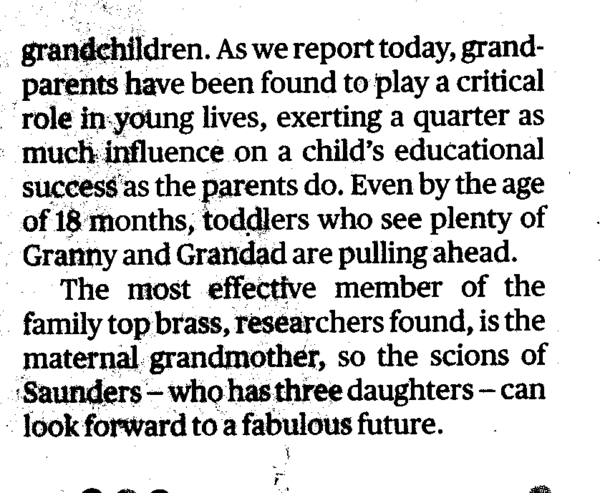
Spotted in an editorial in the Sunday Times 24 May 2026: "Grandparents have been found to play a critical role in young lives, exerting a quarter as much influence on a child's educational success as the parents do. Even by the age of 18 months, toddlers who see plenty of Granny and Grandad are pulling ahead."

The trigger for this editorial came from two news items: one about Jennifer Saunders' new status as a celebrity supergran, and one about a recent report published by the Social Mobility Commission entitled "The Role of Families in the Educational Outcomes of Children and Young People."

Neither of these news items specifically mentioned estrangement but the implications are clear: EAC who prevent contact between their children and grandparents for no good reason are doing their children a disservice.

For copyright reasons I can only reproduce an short extract from the editorial here, but you can find the originals at:

www.thetimes.com/life-style/celebrity/article/jennifer-saunders-absolutely-fabulous-interview-tv67twqqm

www.thetimes.com/comment/the-times-view/article/jennifer-saunders-vegetable-patch-grandchildren-grandparents-hmq90kbm5

socialmobility.independent-commission.uk/publication/the-role-of-families-in-the-educational-outcomes-of-children-and-young-people/

The two Times articles are behind a small paywall; the Social Mobility Commission report is free.

bakestrategic Mon 29-Jun-26 13:29:55

Smileless2012

^I don't think a parent is ever responsible for everything that happens to a child^; at last, something that makes sense.

It’s so interesting that I’m trying to communicate something that I think EAC try to communicate to their parents, the importance of impact over intent (which has articles and articles freely available on the internet describing it) and you respond with dismissiveness, condescension, and no curiosity. It’s also fascinating how my sentences charitable to parents are comprehensible to you, but that ones that aren’t may as well be in another language.

Smileless2012 Mon 29-Jun-26 14:28:43

I've already explained my point of view that when talking about intent and impact, intent takes precedence over impact because if the intent is to inflict pain and suffering, be it emotional or physical, the impact on the recipient's mental well being will be worse.

Your premise comes across to me that any issues in the relationship between and AC and his/her parent(s) stem from childhood and although this of course is sometimes the case, it isn't always.

From the link you provided it states it is also important for the hurt party to extend forgiveness where possible especially when the intent was not malicious. This not only supports my point of view of the importance of intent, but also the necessity for the 'injured party' which for the purpose of this discussion is the AC, to understand and accept the fallibility of their parent(s).

Also from the link is pause before responding take a moment to reflect how your words or actions might be received. Good advice for parents and their adult children.

Without specific examples of EAC's experiences of trying to engage with their parents about how certain events in their childhood made them feel that their emotional needs were not met, this link is just as applicable to all relationships.

IMO you've tried to make impact and intent specific to parent/child relationships with the onus on parents, and the link you've provided simply isn't specific enough to do so.


bakestrategic Mon 29-Jun-26 14:46:45

From the link about intent vs impact, "This distinction can be crucial in relationships because we often prioritize our intentions, expecting others to automatically understand or accept them. However, as much as intentions matter, the way our actions impact others is ultimately what shapes their feelings and responses."

Your point of view that intent takes precedence over impact is simply incorrect in the majority of cases, and your explanation that intent may make the impact worse doesn't refute that the impact is what matters.

giftfamilyservices.com/intent-versus-impact-why-it-matters/

www.coachhub.com/blog/intent-vs-impact

The onus is on parents because even when children become adults, the parent-child dynamic is still at play in some respects. However, I realize I can explain and re-explain and provide source after source of obvious facts, but people can't be made to understand things that they refuse to consider.

Smileless2012 Mon 29-Jun-26 15:34:38

My point of view doesn't have to be correct because it's my personal perspective.

I disagree with you bakestrategic not because I don't understand or need to be made to understand and not because I haven't considered your perspective, I just don't agree with it.

bakestrategic Mon 29-Jun-26 15:40:45

Fair enough, everyone is entitled to their opinions. What I'm arguing is backed by science and psychology, but everyone is entitled to disagree with those as well.

stillawipp Mon 29-Jun-26 17:24:20

Oh, that all got a bit too deep for me, but isn't the main point that one should always look at both sides?! Most behaviours involve one who gives it and one who receives it. Intent mostly applies to the 'giver' and impact to the 'receiver', surely? And no matter what the intention was, if by your actions you inadvertently hurt or offend someone then you should recognise that and apologise, shouldn't you?
I have no idea which of you that agrees with, but that's my personal opinion!

Smileless2012 Mon 29-Jun-26 17:30:39

Impact can of course dictate the resulting emotional fallout but research also highlights situations were an understanding of intent heavily affects the behaviour, communication and emotional interaction of that relationship moving forward.

For example:-
Malicious Intent vs Benign Intent.
Knowing intent is crucial to assessing the toxicity or volatility of a relationship.

Assuming Positive Intent
Clinical consensus demonstrates that building a habit of assuming positive intent, can cultivate long-term resilience, forgiveness and trust when faced with unavoidable conflict. By the same token, assuming the opposite will of course have the opposite effect.

There are 5 major scientific disciplines in the study of relationships; Neurobiology, Sociology, Anthropology, Evolutionary Psychology/Behavioural Science and Psychology.

The largest contributor is Psychology which encompasses the sub-disciplines of Social Psychology, Clinical Psychology and Developmental Psychology.

What you are arguing isn't backed by all science and psychology. Even the proponents of psychology aren't all in agreement. Freud and Jung for example agreed on the core principles of psychoanalysis but their fundamental views on the human mind differed.

If you'll pardon the pun; 'science is not an exact science'.

Smileless2012 Mon 29-Jun-26 17:36:14

I agree stillawipp that if your hurt someone intentionally or not then you should apologise.

bakestrategic Mon 29-Jun-26 17:45:22

I'm not saying intent is irrelevant and has no effect in relationships, nor that it shouldn't be considered in relationships. I'm saying in terms of repairing relationships, the impact one person had on another is more important than the other person's intent. It's like if you accidentally knock over a glass of juice, no matter how good your intentions were, you still need to clean up the mess you made. Or if you knock over someone else's glass, it's of little use to describe your intent, what matters is making being accountable to the harmed party.

Smileless2012 Mon 29-Jun-26 17:56:12

I know what you're saying bakestrategic and as I've already told you, I don't agree that impact is more important than intent.

bakestrategic Mon 29-Jun-26 18:02:54

Would you agree intent doesn't un-spill a drink like in the juice example?

Smileless2012 Mon 29-Jun-26 18:25:20

Of course. Would you agree that the person who had the drink spilled on them would be more 'hurt' if they knew it had been done intentionally?

bakestrategic Mon 29-Jun-26 18:31:56

Possibly but it would depend on the circumstances between the two parties and other factors, such as if they were friends or strangers, why the did it, etc.. The intent doesn't change the mess, however.

Smileless2012 Mon 29-Jun-26 18:44:48

I'm not saying the intent changes the mess^; ^why they did it etc ie the intent is relevant though isn't it.

bakestrategic Mon 29-Jun-26 18:49:06

Yes, intent is relevant, I never said it wasn't.

Smileless2012 Mon 29-Jun-26 19:22:38

Great; have a good evening.