Gransnet forums

Chat

A question for horsey people

(47 Posts)
BradfordLass72 Fri 13-Sept-19 04:15:19

Quite near my home is a horse breeder who also runs a riding school.
Recently I was talking to her and she explained how she long ago dispensed with bits to control the horses, thinking them cruel and unnecessary.

She explained how many cultures have never used a bit and yet generations schooled, trained and bred horses very successfully.
She also explained that the habit of mounting a horse from the left only came about because, in the past, the sword got in the way!
Now it's done without ever thinking it through and this can actually damage a horse's musculature when they are ridden regularly.

All this was new to me, I have ridden only 3 times in my life, although have always observed how horses don't like that bar of metal across their tongues and how it can tear the corners of the mouth.

So, could you tell me why these practices continue, especially with people who clearly love horses?

Is it true that they just blindly accept what's been done in the past - and don't bother looking for humane alternatives?

nightowl Sat 14-Sept-19 23:12:51

Gabriella we wear shoes but we don’t nail shoes on to our feet.

Hoof boots? Fantastic invention. But even better, if you ride a horse on mixed terrain its hooves will grow stronger accordingly. There is so much learning going on in the horse world at the moment, it’s exciting.

GabriellaG54 Sat 14-Sept-19 23:23:06

If horses didn't get shod or vets didn't trim their hooves, they would become overgrown and cause innumerable problems, as a recent tv programme about abandoned and wild horses showed.
I'vc never heard of spurs being used in the UK, apart from ceremonial occasions when they are part of the rider's uniform and not used on the animal.
Likewise whips. Rarely if ever used and usually only in racing where there are strict rules and a vet who checks horses as they return to the paddock or stables.

GabriellaG54 Sat 14-Sept-19 23:27:32

nightowl
Horses don't have toes or the same shape of 'foot' to keep a shoe on.
That's why stallions often wear boots on their forelegs when covering a mare and she wears them on her hind legs (kicking boots)
They also sometimes wear them when travelling.

GabriellaG54 Sat 14-Sept-19 23:29:50

Hooves are keratin as are our nails. They grow and need regular attention.

BradfordLass72 Sun 15-Sept-19 06:16:46

What a lot of interesting information, I'm truly grateful for it all.

nightowl that's heartening to hear - I grew up hearing that animals don't feel emotions and yet it is so obvious they do.
I think I knew as a child that bits were wrong because horses delivered things to our house all the time and they all 'chewed' on those bits. sad

Some of the Dick Francis books were quite horrific when he talks about the way jockeys act during a race - and he should know.

I also learned horses have their shoes changed for special, thin racing shoes, which are taken off and the regular ones replaced after the race.

Horses were broken harshly in the old days because they had to be dominated quickly as they were needed for working (as with wranglers in the USA). Now, when horses are used mainly for leisure, we don't need to be so cruel.

There's a man in NZ who published a book, 20 years ago, about training horses with kindness, to accept a rider, just as GrannyGravy13 describes.

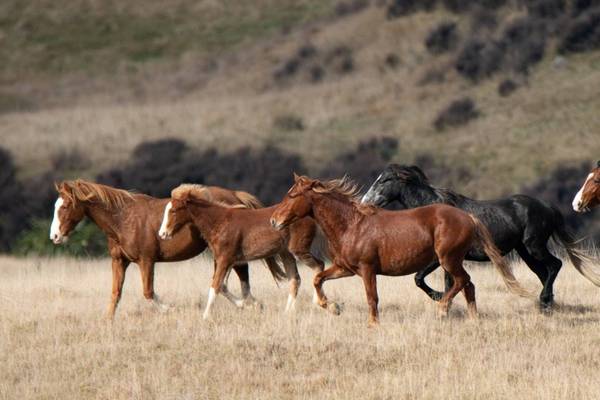
We have Kaimanawa Wild Horses (see pic) in NZ but they are managed by MAF who carry out regular checks and vets visits. Sadly, they also have to cull them sometimes to keep herd size down.

Thank you all again. flowers

ClareAB Sun 15-Sept-19 09:08:32

I'm glad that the way we train animals is being challenged. We use positive reinforcement with our dog, and it works brilliantly. No prong, choke or e-collars, no shouting, hitting etc.
Many people are taking the same approach with horses, and it's working. They don't need bits, whips or spurs. they're for the humans benefit.They need positive reinforcement which helps them love what they do.
I used to ride a lot as a child, and now find it distressing how horses are treated. It's not comfortable examining what we do, why, and the impact it has. But it is the right and kind thing to do.

gillybob Sun 15-Sept-19 09:27:40

My DGD always uses the term “producing” for what would have once been breaking.

She has helped produce a few ponies with a breeder who she wants to work with when she leaves school. Her intention being to go to Equestrian college and work at the same time.

Davidhs Sun 15-Sept-19 09:32:17

The horses we have today are not “wild” they have been selected and bred for different tasks for centuries and do need to be maintained. Feet need to be trimmed regularly and shod if you plan to ride them other than the occasion plod around. They need shelter from the worst of the weather, shade in summer a windbreak in winter, most importantly of all need feeding properly.
The most common mistake is to feed too much, especially moorland breeds, the theme of this thread has picked on bits in a horses mouth, there is probably 1000 times more suffering caused by owners feeding too much. I’ve seen many many horses with Laminitis ( swelling inside the hoof) and other related conditions causing lameness.

By far the most problems are caused by well meaning owners who have no idea how to care for a horse, the vets do very treating the results of ignorance.

notentirelyallhere Sun 15-Sept-19 09:54:35

Good post Davidhs, so many people have opinions about animals, horses included, but have very little real knowledge. My daughter, who has ridden and owned horses all her life, has just finished her PhD on obesity in horses. She was funded by the Horse Welfare Trust.

Her main funding was that people think they are experts on their horses and that they see the horse as an extension of themselves. Hence, people who let their horses grow fat are just like dog owners who can't bear to think of depriving their pets. There is now a huge field called 'human behaviour change in the interests of animal welfare' and she is now doing more research and travelling the UK and abroad giving workshops and papers about this subject.

For those who don't know, horses' teeth have a gap where the bit fits in the mouth. Most horses are now ridden in a bit called a snaffle which is designed to be comfortable though of course it is intended to be a means of stopping the horse so if badly used, it will cause discomfort. A well trained horse actually responds to the rider's weight and intention so a good rider can slow a horse with barely any pressure on the reins.

So called bitless bridles which use a strap across the horse's nose can cut off the breathing so they are not necessarily kinder than a bit in trained hands. I hate those trekking stables for holiday makers where people who think riding is easy are plonked on top so they plod along a beach or up a mountain. An untrained rider can hurt a horse's back by being in the wrong position and lolling about. Learning to ride at a good riding stable will take several years at the least.

Lastly, there is now a movement in the horse world to keep horses but not ride them which is a gesture towards understanding that horses are incredibly sensitive and empathetic animals. Hence, this goes hand in hand with the increasing use of horses as therapeutic animals. They are especially good with disturbed teenagers, autistic people and those with emotional problems.

notentirelyallhere Sun 15-Sept-19 10:00:26

If you want to see more of what horses are capable of, then look at this web page of the paralympic dressage rider, Julie Payne.

I know Julie and she suffers terribly with Multiple System Atrophy. She is a wonderful demonstration of what a horse and rider in tune can do, how the horse will tune into, almost intuit what the rider wants and how to ride with a body that has very little strength in it yet do the most intricate and delicate movement. There is no cruelty here, just understanding and cooperation.

www.equestrianteamgbr.co.uk/team/podium-potential-squad/para-equestrian-dressage/julie-payne/

merlotgran Sun 15-Sept-19 10:03:01

A horse works a bit in its mouth, it doesn't chew it because it should rest in the back part of their mouths where there are no teeth. Saying a horse has 'the bit between his teeth' means he has taken control and you're probably about to end up in the next county! grin

I've schooled and 'brought on' many Welsh Mountain ponies for children. The relationship between a good pony and its rider develops in a beneficial way if they are a suitable match.

Fashions and training methods might change but I'd never allow a child to ride a pony anywhere other than a secure field without proper control.

nightowl Sun 15-Sept-19 10:10:07

smile so many points of view and such strong feelings. Open minds and education are the way to go. As parsley said, we used to think it was ok to dock dogs tails, but thankfully we’re more enlightened now.

After a lifeline of learning about horses, all I know is, many of the things I used to do are wrong, many of the things I used to believe are questionable, and if I live to be 100 still around horses I will never know everything there is to know smile

nightowl Sun 15-Sept-19 10:13:09

ClaireAB I couldn’t agree more

MadeInYorkshire Sun 15-Sept-19 10:32:34

Shysal

Just like some people some do and some don't! The adage "you can take a horse to water, but you can't make it drink" is a true one! If you have ever tried t make a horse do something it doesn't want to do you will have a battle on your hands!

My old boy loved this time of year with the stubble underneath his feet most of all and there was 'no way' despite being arthritic he wouldn't have had a go! Racehorses love it, it is what they do, just watch ENABLE finishing her races, she knows how good she is and just loves the attention it gets her!

www.youtube.com/watch?v=fWh04lYDeNw

Alexa Sun 15-Sept-19 10:42:12

BradfordLass, when I learned to ride I was a child and only when I was older I asked questions about animal welfare. I think your horse breeder friend is ahead of the consciousness of the times.

I could ride my little horse with a neck rein when she was en route to her feed or on the way home but not when she was hotted up. I wish your horsey friend well .

Davidhs Sun 15-Sept-19 12:08:10

It was really strange my daughter ( experienced rider) paid a “Horse Whisperer” to check out her 2 horses. The lady around 40 I guess talked to each horse for about half an hour. Not exactly conventional but the results had a serious ring of truth, one horse didn’t like traveling backwards, or the saddle that was used for competitions the other didn’t like the field they had and his stable was too draughty, a whole list of other things.
It’s easy to dismiss the findings but there was a ring of truth that she could not possibly have known, if only we could all communicate at horse level.

Granarchist Sun 15-Sept-19 12:43:24

Our DGD's pony definitely wants to be ridden! He neighs for attention the minute he hears our back door open and also when DGD calls from her bedroom. He comes straight up the field as soon as he knows we are about and licks us all over if he can! He has other horses to talk to etc but it is human company he craves. I have had horses for over 60 years and have rarely seen this behaviour before. We adore him - as did his previous owners. It is interesting that when I evented at a high level - when we turned horses out for their annual rest, they were very happy for a couple of weeks but after that were hanging over the fence wanting to be doing something.

notentirelyallhere Sun 15-Sept-19 12:49:07

Davidhs I've seen a similar demonstation of animal communication from someone called Susie Shiner, she's in Dorset I think now. I subsequently did a course with her and it's extraordinary how accurate some of the information can be that the horse whisperer couldn't possibly have known.

I wonder if you or your daughter have ever read The Tao of Equus: A Woman's Journey of Healing and Transformation Through the Way of the Horse. A completely fascinating account of connecting with horses. Here is the Amazon description:

^In The Tao of Equus, author Linda Kohanov intertwines the story of how she awakened to the spiritual presence of horses with compelling mythology, research, and personal anecdotes. The result is an extraordinary story of healing and communication that turns our conventional understanding of these amazing creatures upside down.
A horse trainer and equine-facilitated therapy practitioner, Kohanov first began exploring the horse human connection in the early 1990s. When her black mare, Rasa, became lame, Kohanov was plagued by a series of sinister dreams and premonitions. Finally, prompted by her dreams, she canceled a risky surgery to save Rasa's potential career in competitive riding. To relate to the injured horse outside conventional equestrian pursuits, Kohanov immersed herself in the day-to-day activities of the herd. In the process, she discovered that horses are intensely emotional, intuitive, intelligent beings. They are true reflections of our deepest souls. Over time, she discovered their extraordinary ability to awaken intuition in humans, while mirroring the authentic feelings people try to hide, makes these animals powerful therapeutic teachers.^


GabriellaG54 Sun 15-Sept-19 13:49:52

That last sentence (in the quote) makes no sense whichever way you read it, nor does the text say how the injury occurred or indeed how or whether the horse's lameness was healed.

notentirelyallhere Sun 15-Sept-19 14:35:05

I think you have to read the book Gabriella! The horse was healed, the end of the story is quite moving. The author's story was about the ways in which horses reflect our innermost feelings so that there's no hiding, if you're afraid, a horse will know regardless of how well you think you hide it and so on.

As I said earlier, horses are now being used therapeutically with disturbed teenagers and so on.

GabriellaG54 Sun 15-Sept-19 15:13:27

Thank you, notentirelyallhere