Gransnet forums

Chat

Floods!

(263 Posts)
Lona Sat 05-Dec-15 17:15:01

Having just watched the news, I'm hoping that all our Gn members in Cumbria and the North are safe. I don't think I've ever seen so much widespread flooding.

Anya Fri 01-Jan-16 09:18:44

Thanks for that link Elegran I hope people will read it.

It reinforces what I posted earlier, and with illustrations and added explanations and tries to put forward the point that so much more can be out in place to minimise the impact of increased rainfall.

The Northumberland flood management scheme is one I'm familiar with and is an example of what more can be done with imagination, expert knowledge and joined up thinking.

Elegran Fri 01-Jan-16 02:18:07

Storm Frank: What have we done to make the flooding worse? BBC Magazine

M0nica Thu 31-Dec-15 18:15:26

If you have watched any of the tv coverage of the flooded areas, one of the most significant points is that the vast majority of houses being flooded are not modern estates where developers have got planning consent from local councils.

The vast majority of these houses are small terrace houses built over 100 years ago before any planning laws existed. Most of the flood plain building was done during the industrialisation of the 19th century when Victorian developers threw up tens of thousand of small cheap houses on the cheapest land, which was of course on the flood plain to house the workers flooding into towns to work in the factories that were being built.

Most people have very little control over where they live, they go where they can find work and most people start life at the bottom of the housing ladder, whether buying or renting, and in most towns the cheapest properties are the little 19th century terraced cottages on the flood plain. They do not have a choice, they cannot afford to rent or buy in other areas

This is how DS started his home owning career with just such a little cottage on the flood plain because he could not afford housing anywhere else in York on his salary He sold it to his SiL after his childeren were born, when he and DDiL bought a bigger house, which happens to be above flood level. Fortunately he just missed being flooded in 2000, since then the flood defences in that area have been flooded and the house hasn't flooded this year, but in both years he, and now his SiL were close enough to being flooded to have the front and back doors sandbagged and have moved all their downstairs possessions to the upper floor.

Dealing with the flooding is not just the responsibility of the authorities , home owners need to do more to make their properties flood resistance. In York all the businesses and properties on the banks of the Ouse that flood every year have tiled floors, walls lined with water resistant plaster and the elctricity circuits are at waist level, if not higher. Some pubs even have the furniture screwed to the floor. When the flood come any soft furnishings are quickly removed. After the flood the flooded areas are hosed down with high pressure hoses and are back in use within a couple of days.


durhamjen Thu 31-Dec-15 15:09:38

Every time someone puts in for planning permission, they have to do a flood risk assessment, no matter what size the development.
York has a 104 page document about flood management.

The people who put in flood risk assessments for the builders are paid by the developers, which is why they are subjective reports. The developer for a site of 149 houses in this village has had his plans turned down twice by the council and has now gone to appeal. From now on, it's nothing to do with the planners, just central government, who know nothing about the village. Our MP does, because she lives here. Unfortunately for the village, she will have no more say in what happens than ordinary villagers, as she is a Labour MP.

There are plans in for another 350 houses in this village, which cannot cope with the number of residents it has at the moment.

durhamjen Thu 31-Dec-15 14:14:55

That's one reason, granjura, why I wish we could get over the obsession with GM foods and look at growing more organic food. It would go back to better farming practices for the soil as well as crops and animals.

granjura Thu 31-Dec-15 14:11:11

One factor rarely talked about in the media is the recent compaction of soils in the UK- with over grazing of uplands (eg water from hills runs off very quickly downhill rather than part being absorbed) and then compaction of soils in plains below, due to extensive modern farming. Old fashioned soils with plenty of worms, etc, absorb water well- compacted soils do not. Just one factor among so many... but rarely mentionned.

whitewave Thu 31-Dec-15 13:19:01

Yes rose that is why they work so closely with other academic institutions and charities etc. Everyone seems to be continually working on and updating information and practical input.

rosequartz Thu 31-Dec-15 13:15:26

My DH is doing his PhD in one tiny aspect of all this and although his brain is coping with the details of his one little aspect the maths is so far beyond me... About as far as A level maths is beyond a normal 4 year old. (I speak as someone who tried and failed to pass A level Pure Maths)

Well, that is what I was trying to say, and I didn't mean to cast aspersions on such as your son whitewave and his colleagues who I am sure are all extremely knowledgeable in their field and know a lot more than those making a lot of the decisions.

It is such a hugely multi-faceted problem I wouldn't think any one person or even one branch of science can cope with the complexities of how, why and what we should do about it.
Along with a good dose of common sense which some planners/builders seem to be lacking.

I need some lunch before I tackle your link JessM
Thank you!

whitewave Thu 31-Dec-15 13:08:28

grin now that really is silly, whoever said that. Be interested in seeing the evidence.
There are masses of long term plans it is just trying to convince a short term government.
There is no alternative at the moment to flood defences. Come that glorious day when they are redundant may be a tad while off.

JessM Thu 31-Dec-15 13:05:12

Here is an interesting article written for a general audience that explains some of the factors and the complex interactions between them.
There is lots of good science involved but it is incredibly complex. Meteorology, oceanography, research into paleobiology and ice cores to name but a few areas.
There is an extraordinary high level agreement in the scientific community about global warming, with just a tiny number of academics making a name for themselves as dissenters (when it comes to causes of recent warming). The science is rock solid: more CO2 has always = a warmer planet. How and where ice sheets form and melt and how the ocean and weather patterns contribute is the complex area most are trying to understand.
My DH is doing his PhD in one tiny aspect of all this and although his brain is coping with the details of his one little aspect the maths is so far beyond me... About as far as A level maths is beyond a normal 4 year old. (I speak as someone who tried and failed to pass A level Pure Maths)
In a previous business role he sometimes tried to explain relatively simple stuff, to do with heating and insulation of houses, to civil servants and ministers. Head, brick wall etc. They are not, typically, at all technically minded or interested in things technical or scientific.

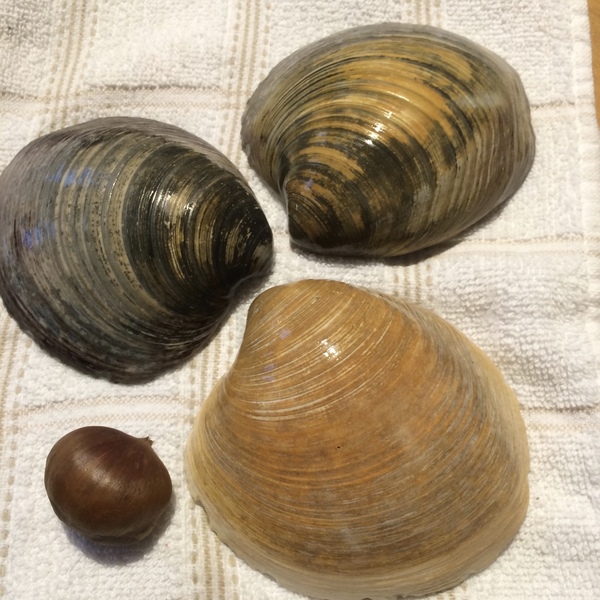
Ive included a photo of some Arctic islandica clam shells I collected earlier. Chestnut is to show scale. This species is thought to be the longest living animal on the planet (up to around 500 years) and is studied because it has so many growth rings - like a tree. This can give information about aspects of the sea bed. Just one line of enquiry.

www.scientificamerican.com/article/what-thawed-the-last-ice-age/

rosequartz Thu 31-Dec-15 12:57:13

No!! It would be interesting to know about long-term plans, not just flood defences that may be overwhelmed.

Thank goodness about the next ice age - I thought I heard somewhere it could be in about 10 years' time.

whitewave Thu 31-Dec-15 12:53:04

When you say it is not long rose you are probably talking hundreds of years - in the meantime - do we do as Nero?

rosequartz Thu 31-Dec-15 12:49:30

Of course, as some experts believe that a period of global warming precedes another ice age it may not be long before we are all frozen and the seas retreat.

I don't know whitewave, but planning ahead needs to be a priority.
People who have asked for permission to raise their homes on to stilts as in other flood-prone countries have been denied planning permission.

whitewave Thu 31-Dec-15 12:47:14

They do rosequartz but do not have the legal ability to stop them

whitewave Thu 31-Dec-15 12:45:45

So in the meantime how are we to protect our infrastructure like bridges, roads, electrical and gas installations and our nuclear generating sites?
What if you live in a flood prone area? What do we suggest they do poor buggers - adaptshock

Elegran Thu 31-Dec-15 12:43:55

Best attack the problem on all fronts, too, with government, local authorities, housing developers and Joe/Josephine Bloggs who is buying a new house in a vulnerable area all aware of the possibility of there being more water than usual. Blaming one section shifts it nicely from everyone else, it doesn't solve the problem and stop it happening again.

rosequartz Thu 31-Dec-15 12:43:44

They need to shout a bit louder then whitewave to educate the planners!

whitewave Thu 31-Dec-15 12:41:19

Like my son jing He is responsible for the South Coast from Southampton to Kent.
The staff are highly educated - most with PHDs in environmental sciences etc. They employ a wide range of experts and work widely with other agencies and charities. I will not go into what he says as this would perhaps betray his trust. What I say on GN is what can be gleaned from media.

rosequartz Thu 31-Dec-15 12:40:47

So rosequartz What do you suggest we do?

This problem seems bigger than present-day brains can cope with

Adapt as the primitive Aboriginal people did? Instead of trying to fight it or carry on as if it isn't happening, eg as in the proposed building on a flooded site in Anya's link above.
Heads in the sand (or floodwater).

jinglbellsfrocks Thu 31-Dec-15 12:35:33

Some of this is probably down to us. A lot of it is most likely normal climate change. The sort that has always happened.

Best to go along with the measures suggested by today's scientists.

jinglbellsfrocks Thu 31-Dec-15 12:32:46

Oh! I didn't realise -rq was a big-shot in the environment agency!!

What's that? She's not? Go and ask someone who is then! hmm

jinglbellsfrocks Thu 31-Dec-15 12:30:18

There has always been flooding.

Just saying.

whitewave Thu 31-Dec-15 12:29:59

So rosequartz What do you suggest we do?

rosequartz Thu 31-Dec-15 12:26:07

Anybody believe the experts?

Well, which one to believe as they disagree amongst themselves endlessly as to cause and effect?

No-one really seems to know all the causes. No-one knows what the outcome will be.

This problem seems bigger than present-day brains can cope with.

rosequartz Thu 31-Dec-15 12:22:42

Did anyone watch David Attenborough's programme about the Great Barrier Reef last night? It was interesting to note that the Aboriginal people who live near Cairns have passed down legends through dance about the time, 14,000 years ago, when the ice sheets melted and the sea covered the land they lived on. This warming was very rapid and happened in a generation - the land stretched as far out as the continental shelf which is just beyond the Great Barrier Reef (the reef has formed since that time). The distance from Cairns to the Reef is over 50 kms (an hour and a half by boat).

Scientists are just discovering about this now. hmm
(Perhaps they should have asked the native Australians)

I don't think there is anything we can do to stop this happening, tinkering at the edges by stopping the burning of fossil fuels may help somewhat, but if there was such a rapid rise in C02 all those thousands of years ago what caused it?

We need to look at adapting our lifestyles and where we live, not trying to push back the waves like latter-day King Canutes.