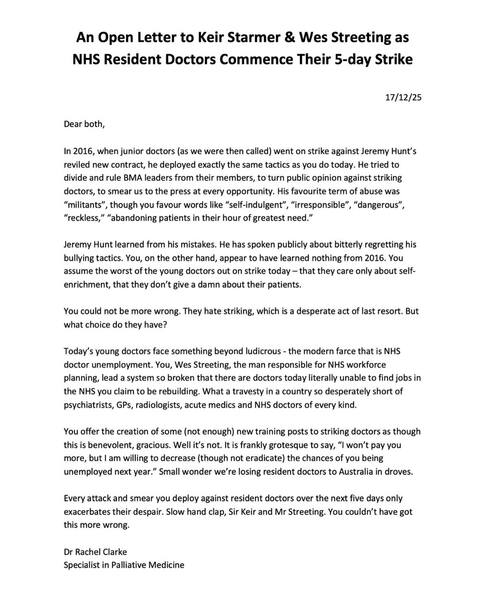
For all that work and aptitude with 4 A* A levels in STEM subjects this is the reward.
UK “resident” doctors (junior doctors) start on around £39k and can reach £70k+ during training, after 5–6 years at university plus at least 2 years foundation training, and they typically graduate with £70k–£80k+ of student loan debt (often never fully repaid under the current system).[1][2][3][4][5]
## Pay levels (England, 2024–25 ballpark)
Basic pay before banding, nights, weekends and on‑call supplements:
| Training stage (junior doctor) | Typical basic annual pay |
|--------------------------------|--------------------------|
| Foundation Year 1 (FY1) | ~£38,800[2] |
| Foundation Year 2 (FY2) | ~£44,400[2] |
| Core / early specialty (CT1–2/ST1–2) | ~£52,700[2][6] |
| Higher specialty (ST3–5) | ~£65,000[2][6] |
| Senior specialty (ST6–8) | ~£74,000[2][6] |
Actual take‑home is higher once you add extra hours, nights and weekends; an ST3–4 with rota supplements can approach ~£90k–£100k total before tax in some posts.[6][7]
## How long they spend in university and training
- **University (medical school)**:
- Standard undergrad medicine: 5 years (often 6 with an intercalated degree).[3][8]
- Graduate‑entry medicine: typically 4 years.[3]
- *Postgraduate training path (minimum):*
- Foundation Programme: 2 years (FY1–FY2).[8][3]
- Specialty training:
- GP: usually 3 further years after foundation (so ~10–11 years total from starting medical school).[8][3]
- Hospital specialties: 5–8+ further years (so roughly 13–15+ years from starting medical school to CCT/consultant).[3][8]
## Typical debt on graduation
- Analyses using pre‑2012 fee levels already found *tuition‑fee debt alone ~£40k*, with full loans (fees + maintenance) modelling *initial debt up to ~£82k (2014 prices)* for students living away from home.[4]
- More recent modelling for the £9,250‑fee era estimates *typical medical graduate debts around £64k–£82k*, depending on living at home, location and maintenance borrowing.[5]
- Because of interest and the 30‑year write‑off, most UK doctors are *unlikely ever to fully repay* their medical school loans; many will have a balance written off after 30 years of repayments.[4][5]
[1](https://www.gov.uk/government/publications/national-pay-scales-for-eligible-healthcare-jobs/national-pay-scales-for-eligible-healthcare-occupation-codes)
[2](https://procalculator.co.uk/junior-doctor-salary-calculator/)
[3](https://blog.medlinkstudents.com/how-many-years-to-become-a-doctor/)
[4](https://bmjopen.bmj.com/content/5/4/e007335)
[5](https://www.pulsetoday.co.uk/news/practice-personal-finance/medical-students-unlikely-to-repay-student-debts-during-working-life/)
[6](https://www.nuffieldtrust.org.uk/resource/exploring-the-earnings-of-nhs-doctors-in-england-2025-update)
[7](https://www.pulsejobs.com/news/resident-junior-doctors-pay-scales-in-england/)
[8](https://www.learndirect.com/blog/what-qualifications-do-i-need-to-become-a-doctor)
[9](https://www.nhsemployers.org/system/files/2025-02/Pay-and-Conditions-Circular-(MD)-5-2024-R2.pdf)
[10](https://www.bmj.com/careers/article/the-complete-guide-to-nhs-pay-for-doctors)