Is this just happening more recently.
MIL was in one, over 10 years ago, and it sold again very quickly. With profit.
Only 50% of middle age adult manage more than 1 brisk 10 min walk a month.
Sign up to Gransnet Daily
Our free daily newsletter full of hot threads, competitions and discounts
Subscribe
Is this just happening more recently.
MIL was in one, over 10 years ago, and it sold again very quickly. With profit.
My daughter-in-law is trying to sell her deceased Mother's flat with an annual service charge of £5000. Not one wants it at half the price paid for it (£135,000 down to £70,000)
However, if you can get these properties cheaply and you are in your eighties, can you live with £5000 a year service charge knowing you have saved a large sum of money?
butterandjam
Norah
Chocolatelovinggran
Of course, Norah, you are right. However, I would be reluctant to leave my children such a problem, in which they must continue to pay the service charge, of several hundred pounds a month, on a property that might take a long time to sell.
It would seem the executor or administrator is responsible for managing ongoing costs from available estate funds until property sale is complete.
Correct me if I'm wrong, please, aren't all debts, liabilities and taxes paid before heirs receive? If so, that solves any problems.Very often the Executor will be the child off the deceased.
Some debts accumulate on a property after death of the owner, like Council tax, property insurance and essential repairs, management fees.
The estate may have no money to pay those expenses, until the property has been sold.
Fair enough.
Since the place you live in is a home not an investmant, sell it even if at a 'loss'. If this results in a nil estate, so be it. None are entitled to a legacy.
Norah
Chocolatelovinggran
Of course, Norah, you are right. However, I would be reluctant to leave my children such a problem, in which they must continue to pay the service charge, of several hundred pounds a month, on a property that might take a long time to sell.
It would seem the executor or administrator is responsible for managing ongoing costs from available estate funds until property sale is complete.
Correct me if I'm wrong, please, aren't all debts, liabilities and taxes paid before heirs receive? If so, that solves any problems.
Very often the Executor will be the child off the deceased.
Some debts accumulate on a property after death of the owner, like Council tax, property insurance and essential repairs, management fees.
The estate may have no money to pay those expenses, until the property has been sold.
My DH and his brother sold his mother’s McCarthy and Stone flat at half what his mother paid for it, bought from new. The whole saga lasted nearly three years. They rented it out to cover the fees which were still payable despite her death because they couldn’t sell it. They feel very lucky to have sold it now. Hindsight is a wonderful thing but we have said we would only move into one ourselves if we rented. We wouldn’t want our own kids having this problem.
I have actually mentioned this before. When I retired, my boss who was a solicitor, made me promise never to buy a retirement flat like Maccarthys as he had dealt with so many frustrated clients in tears over it all when they couldn't sell them on and lost so much money.
There are a lot of them in my home town, and whilst I would struggle with lack of space, I can see why people are attracted to them. They are centrally placed, and from what I gather there are communal spaces in the blocks, so people get to know the neighbours, and there is a certain amount of socialising, which prevents loneliness.
We have the McCarthy and Stone ones, and another similar company, which I think is more expensive. There is also an older development which has houses as well as flats for older people. Again, it has a town centre location, and has a warden on site. There is no service charge for these ones, but the warden and garden services etc are paid when the properties are sold. The charge is a percentage of the sales price - not sure what it is, but I think it exceeds 10%. If you live there from say, 55 to 90 years old, that might be a reasonable deal, but if you have to sell after a couple of years it's a big loss. They are popular though, and there is usually a waiting list.
In all cases, if a resident develops dementia they have to leave, which would also put me off. The last thing you need with a diagnosis like that would be to be forced out of your home.
Pros and cons, I suppose. For someone recently widowed, or who has moved to a new area to be near family or something, they offer hassle free move (which may also explain why new ones sell better than older ones) and a good chance to make new friends. For people without heirs, who might not care so much about leaving an inheritance, the costs might be less of an issue, too.
£1000 a month though😳. I didn't realise they were as high as that! What does that cover?
On the other hand, if your beloved relative had gone into a care home would anything be left?
The management fees are out of order.
They are not an investment.
Chocolatelovinggran
Of course, Norah, you are right. However, I would be reluctant to leave my children such a problem, in which they must continue to pay the service charge, of several hundred pounds a month, on a property that might take a long time to sell.
It would seem the executor or administrator is responsible for managing ongoing costs from available estate funds until property sale is complete.
Correct me if I'm wrong, please, aren't all debts, liabilities and taxes paid before heirs receive? If so, that solves any problems.
Of course, Norah, you are right. However, I would be reluctant to leave my children such a problem, in which they must continue to pay the service charge, of several hundred pounds a month, on a property that might take a long time to sell.
Someone I know bought a "retirement flat" second hand because it was such a bargain knockdown price. She's a lone widow and likes the security of the onsite management services. What makes them hard to sell is the occupier restrictions, must be occupied by retired person. Plus high management fees.
We bought a flat in a private development whose location quality and price range appeals to affluent older people. More than 3/4 of residents are active retirees like us, and its a perfect "lock up and leave" There are a handful of younger professionals, and one resident child. There's no live-in management but we have a residents group and a factor who handles communal expenses such as the excellent maintenance of our large and very beautiful grounds and woodland. Communal expenses are under £ 4 hundred pa. per property Many of us privately employ the same excellent cleaner and window cleaner.
If you can find a similar set up and can afford your own support care if you ever need it, it's a far better deal than managed retirement developments IMO.
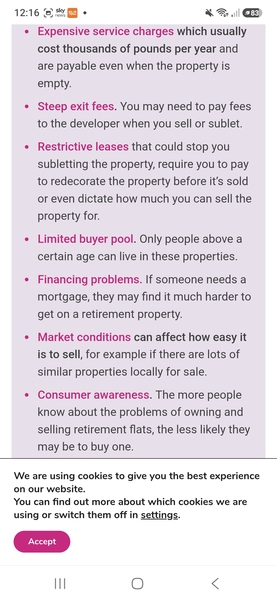
Found this on the Homeowners alliance
It seems to be a similar issue with apartment blocks. A friend recently took two years to sell a very pleasant two bedroom apartment in what had been a mill. Architecturally beautiful building surrounded by by gardens and in a sought of area. She said the maintenance costs rocketed and this put people off
It seems to me if a person buys new, everything is perfect and will 'see them out' - perhaps the ultimate downsizing. They also may not care about the value after death - no pockets in a shroud.
Its shocking how fast these properties lose money, where I live a house bought say 5 years ago for £325,000 would now realise £425-450,000 ish. The same price for a flat in a'McCarthy & Stone' type development bought 5 years ago is falling so fast its unbelievable - £95000!
The service charges have rocketed up to £6000 yearly. I can only think the Grand Opening -champagne launch must be pretty dazzling!
I've never come across such depreciation in property. I think the service charges continue to mount up until a new buyer is found too.
My sister and I inherited my Mother's Flat in one of these complexes. She was very happy there and it was beautiful.
However, it took us 2years to sell it after she died and cost us around £10k, just in keeping it empty, the changes still have be paid.
Why don't they sell? has to be the charges, when she moved in it was fine but they go up faster than they should.
The two companies that you pay, are awful, they never reply to questions, or any communication. We thought about renting it out but couldn't ever get a reply, as the House manager said we had to speak to them directly. However they hound you if you are late paying a bill (by a day or two).
When you finally sell, after new tenant is in situ and paying, you still get these service bills sent to you. I gave up and just, put Return to sender not know at this address on the envelopes.
This type of living is lovely But costs too much.
This is what I understand to be the case, M0nica. It would certainly be one of the reasons that I would not be comfortable purchasing one.
I think the " new builds" are very shiny and the show flat looks wonderful.
Also, developers learn from previous developments, and add in things that they realise are important/ attractive to their market. For example, some of the older apartments have only communal gardens, whereas the newest ones near to me all feature a small balcony.
The story i read was a real horror story. Unable to sell the flat the deceased's family had to put the flat into administration and hand everything over to the administrators. the main debts were maintenance charges of !1,000 pus a month. In th end the lease was surrendered to the leaseholder and the whole estate was valued at nil.
I am very curious why people are willing to buy new retirement flats, but not secondhand ones. The main problems with these flats - high maintenance, taking a cut of the capital, etc apply whether the buyer is the first buyer or the tenth.
As most of us are in the retirement flat age group, and a number live in these flats, we are the oens mosst likely to be able to say what the problem is.
I must confess, that retirement flats are not my schtick. This does not mean I am opposed to them or dismissive of them. mainly for me they are faar too small, but I have friends who live in them and are very happy there, but I worry what will happen to their flat when they die.
But my main uestion is 'Why do these flats have such a poor resale market?
Registering is free, easy, and means you can join the discussion, watch threads and lots more.
Register now »Already registered? Log in with:
Gransnet »Get our top conversations, latest advice, fantastic competitions, and more, straight to your inbox. Sign up to our daily newsletter here.