You get 10 times more yield per palm oil tree than any oil crop.
Men asking questions from another room!
request to use less electricty 6pm till 8pm this Wednesday


Thinking about things of I have read on here and other social media and realise that many people are not buying anything with palm oil in but that is a mistake.
Last night we were chatting with a man from WWF and got onto this subject. He reminded me of a news item I had seen about growing palm oil. It is a good thing to do and is a much more environmentally friendly crop to produce than many of the alternatives, if it is grown sustainably. The issue arises when forests are destroyed to grow it inefficiently.
So we should be looking at where producers buy their palm oil rather than refusing to buy anything containing it. If we stop buying it altogether we will be doing more damage than we are at present.
I googled it and found: 6gupp2m546k1gbxng1rlf2m3-wpengine.netdna-ssl.com/wp-content/uploads/2018/08/SustainablePalmOilShoppingList-v2Aug2018.pdf
and {https://www.theguardian.com/sustainable-business/2014/nov/26/10-things-you-need-to-know-about-sustainable-palm-oil} if you don't want to read the whole article:
9. Consumers should not boycott palm oil
They should boycott unsustainable palm oil. McCoy says: “Palm oil is an incredibly high-yielding vegetable oil, which means that anything replacing it will have to use more land - that does not solve the issue of deforestation and associated land use change. Better to get palm oil production ‘right’ to avoid leaking the issue elsewhere to another commodity.”
You get 10 times more yield per palm oil tree than any oil crop.
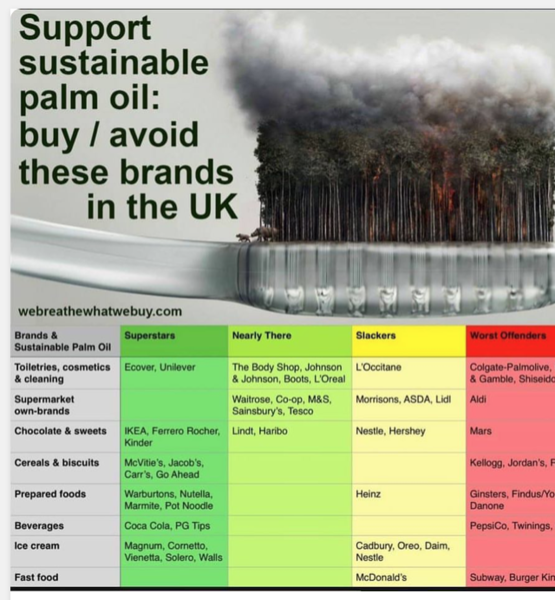
I've managed to find a picture which was on the website. I thought it was quite useful:
I think, like Brexit, everything is more complex than it at first appears.
If we look at research that has been carried out very recently, say over the last year, it seems as though the "sustainable" palm oil is not as well regulated as you might think.
Here's a PNAS (National Accademy of Science) study, for example "Effect of oil palm sustainability certification on deforestation and fire in Indonesia" which says that although 20% of global palm oil production was certified sustainable in 2017, and demand is increasing for sustainability, the measures used to monitor deforestation are inadequate and overlook linked issues. Clearly there is commercial pressure to become "sustainable" and the RSPO (the certificating body) has been criticised 'for “greenwashing” palm oil grown in recently cleared forests and drained peatlands' in order sign more farmers up to the code. www.pnas.org/content/pnas/early/2017/12/05/1704728114.full.pdf
I honestly don't know enough about this issue I think.
Hang on, Atora is supposed to be suet? They put palm oil in suet? What on earth????
You are absolutely right NotSpaghetti. It is extremely complex. And I think we need to be careful not to get bogged down or sidetracked by the simplistic notion that boycotting a brand of biscuit that contains palm oil if going to make that much difference. What will make a difference is if people start to think about their overall consumer habits and make a concerted effort to reduce the amount we consume. Why? Because everything we buy will have made some use of palm oil in the supply chain. Manufacture and transportation use huge amounts of palm oil in the form of biofuels. The end product may not physically contain palm oil but it will have been used in production and transportation at some point. It is impossible for the world’s population to consume in the way it does now from sustainable production.
Putting aside the whole question of orangutans and sustainability - why is everyone just accepting palm oil in our food? That's what I don't get. Why are we eating massive amounts of something that is grown on the other side of the world? Why aren't people supporting local? It has been gradually snuck into our food over the years; when we were young it was only in toiletries. The problems that are happening now with palm oil is because it's being put into so many of our foods so that manufacturers can maximise profits. If we weren't eating so much of it then there wouldn't be the demand - I'm sure none of us decided a few years ago that we would just love to be stuffing our faces with palm oil. It's been forced on us, our choices have been utterly narrowed. And it is disgusting - you only have to taste Cadbury's chocolate now to see how different the taste is from when it was made with cocoa butter. I boycott palm oil for that reason - I simply don't want to eat it - I'd rather have butter and olive oil. Therefore I don't eat manufactured biscuits and cakes apart from all butter ones but they have to really be sought out. Bread without palm oil is hard to find and I find that outrageous, it's a staple food. I'm glad there's a massive backlash happening - we've all sleepwalked (sheepwalked) into this and we need to wake up. It's too early to tell the long term health effects of constant palm oil in our food but it's interesting just as an observation that obesity seems to have increased more or less in line with the amount of time that we've had palm oil forced on us through every loaf of bread and biscuit we buy.
Nonnie info about coconut oil-https://www.theguardian.com/food/2018/aug/22/coconut-oil-is-pure-poison-says-harvard-professor
Nonnie I'm returning to this to say thank you for starting the thread. It's caused me to take a deeper look at the issues and it's been interesting and educational to me.
I've discovered that many U.K. food manufacturers/retailers use only sustainable palm oil e.g. M&S and Waitrose. Also that palm oil is a very efficient crop to grow and to boycott it altogether would deprive small farmers of their livelihood and any replacements such as soybean or coconut would use up to four times as much land as palm does.
I also found this useful list of products. www.ethicalconsumer.org/palm-oil-free-list
Many thanks to NotSpaghetti and SueDonim for the informative links. Shocking to read that more than 50% of supermarket products contain palm oil. It's much cheaper than rapeseed and sunflower oil of course hence businesses prefer it.
I am skeptical regarding so-called sustainable palm oil because as already mentioned there is no international governing body. I also do not like to think of the stuff being transported over long distances and being added to foods and toiletries without clear labeling. Just checked a loaf of bread bought from my local bakery to find it's made with rapeseed oil. Phew!
Just been reading that the native workers in large plantations are exploited and working in dangerous conditions.
As Oakleaf and others have said, it is impossible to avoid using palm oil. But by cutting it out of our home consumption we can hopefully (if enough of us do it) reduce the demand so that few areas of virgin forest get destroyed. At least we can try.
Thanks for starting this thread Nonnie - some excellent links and information. I’ve tried to read much of it, but it’s a minefield! I think, as someone earlier said, being as thoughtful and considerate a consumer as you can, using and buying as sustainable as possible must be the best way. I try to use fresh ingredients and cook from scratch as much as possible, but I know from my daughters that this is not always possible in hectic family lives. Cost - and time - are factors too for many families. Just off to do some shopping now - I’ll do my best 
The RSPO is the certification body CocoPops but you are in essence still right as according to the PNAS study, it doesn’t have the best way of measuring impact and is trying to grow...
Like other members of the Gransnet community I’m keen to try to minimise harm to the planet for the sake of my grandchildren (and yours), but it doesn’t get easier to pick a path through all the supposedly good ideas. For 40 years I’ve cooked mainly “whole foods” from scratch and rarely bought pre-prepared ones so the palm oil in biscuits situation is not one I’m invested in... I’ve read labels though since the 1970s and still I find lots of conflicting advice/information. In 1986 it was soya, now it’s palm oil. It’s easier to get information now (no need to write to people and wait to see if they reply), or use a university library for example - but it’s also easier to be mislead as everyone is so “savvy” when they push their particular view online and in the media.
Given this, I think we should all be trying to live a little lighter. Each small step is a bonus for the planet even if it seems irrelevant on its own.
I agree with your last two sentences, NotSpaghetti!
The Iceland / palm oil situation is commendable in many ways - but when you look at most of the stuff they sell.... Nevertheless, it’s got us all talking and thinking.
I drove round Malaysia 25 years ago. Certainly wouldn’t rate it as a poor country. Kuala Lumpur makes London look like a s**thole.
Ican thanks for that, it helps to narrow down our choices.
JustGrandma I can't agree with you because food evolves and over time we change our eating habits and not just food. I don't want to go back 50 years, I like the more convenient choices we have now.
It is interesting that the Cadbury thing keeps cropping up, I Googled it yesterday and they are adamant that the product has not changed. Apparently when they changed the look by rounding off the corners (was that to reduce the weight?) people took to social media to complain that the chocolate had changed but it hadn't. It seems we are all easily duped by different hysterical 'news' items.
SueD that is exactly how I felt after my conversation with the WWF man, made me look more deeply into the subject. Like others I had casually accepted all the hype and now know that if everyone stopped buying things with palm oil in we would do more damage than is currently being done. That's a good link but still going to be difficult to be selective with the shopping.
Anja that is something I struggle with, are we judging other countries by our standards? Are such people better off having some sort of employment rather than none? I don't know, I remember having the conversation with my Grandad when I was a child. Ideally all workers in all countries would work under the conditions we have in the UK but is that realistic? As I said, I don't know.
I spent part of my childhood in Malaya (as it was then). In the 1950s and 60s, it was not a poor country then and I do not think it ever has been. It was then a world class producer of rubber and tin
When sister visited Malaysia some years ago the rubber plantations had all been cleaned felled, to be replaced by oil palms.
I think we must accept that merely by existing we are causing environmental damage and that has applied to every human since the first. What we can do is try to tread more lightly, Eat a normal diet, not avoiding anything, but just trying to ensure within reason we are ecological in our decisions. Prefer supermarkets with proven high environmental standards, buy locally produced food, visit farm shops and farmers markets. Yes, they are more expensive, but given that the majority of us are overweight, just buy and eat less.
I "boycott" Palm Oil. I have done so for a very long time . It is quite correct what just grandma says about it having sneaked into foods. Its almost ubiquitous now.
I think you must all have cast iron digestive systems or something because my reason for seeking out palm oil free goods is that they give me chronic indigestion. I know others the same - often younger people too.
I found this out by trial and error when I found that everything I ate gave me indigestion. I took out things one at a time and began to realise the biggest cause of my digestive issues was palm oil in foods I was buying.
Yes, I now cook largely from scratch. I am careful about soaps and such ( again I suddenly got a strange "dobbie " type rash after a shower and realised it was what was in the shower gel.
I also have problems with Garlic . I have an intolerance to that. Probably many people do but haven't yet realised it. Garlic is another ingredient finding its way into all things - did you know cheese and onion crisps now have garlic
in them.... they need to be called cheese and garlic crisps.
I have to read everything. Its a pain but at least I can now go to Iceland and pick food up knowing its not got palm oil in it. Not so garlic I am sure. But its a start.
I think it's only Iceland own brands that do not contain palm oil. They stock other brands that do contain palm oil.
I have not read all the posts so apologies if this has been covered but on the question of using our this or not .. Jamie Oliver said on dealing with the schools meals subject that because of the inability of our systems to digest this particular oil it becomes stored and therefore we become fat!
However .. on a program designed to help bakeries be more successful he recommended not using any other more expensive oils but rather to use the cheap palm oil!!
What a hypocrite!
Personally I eat and/or buy whatever I need for the day in small quantities without worrying about it as there's always another fraudulent deal going on all the time .. that's the world we live in unfortunately . 
Abbey its so good to hear that you too have a garlic intolerance. It took me years to isolate it, after all it’s good for you isnt’ it?! I find eating out a real challenge these days. And I agree, I think a lot of people have a garlic intolerance without knowing it - that bloated feeling?
I do wonder if perhaps if I have a problem with palm oil. My skin has certainly benefited from my avoidance of it in washing up liquid.
Emmaline you may have stumbled on the reason why supermarket bread makes me bloat out! I’m fine with good stuff from our local baker.
Registering is free, easy, and means you can join the discussion, watch threads and lots more.
Register now »Already registered? Log in with:
Gransnet »Get our top conversations, latest advice, fantastic competitions, and more, straight to your inbox. Sign up to our daily newsletter here.