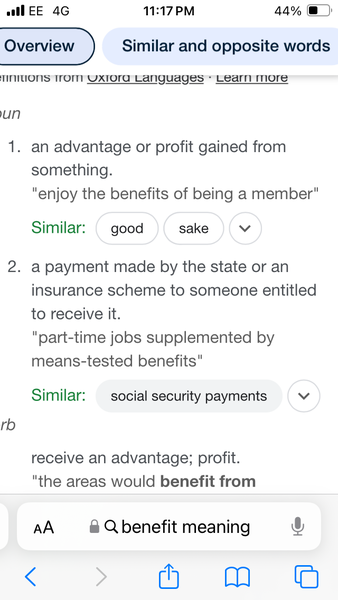
Exactly, Georgesgran.
Many people were members of a Defined Benefit scheme which is paid as a workplace pension. Read the first of the links I posted on Monday. There, the DWP explain why the state pension is a benefit. It’s been defined as such since 1946 - as has already been pointed out by others.
Pensions have always been benefits. The two terms are synonymous. It’s been in the dictionary for centuries. Friendly societies, also know as mutual societies, also know as benefit societies were based on contributions that people paid pennies and shillings into. Many people here will remember paying into, or their parent paying into, policies with companies such as United Friendly or Provident or Prudential which grew out of those societies ... which paid benefits.
Anyone familar with the tax system will understand the term benefit in kind aka perquisites or perks - things such a company car, private health insurance, share options, interest free or subsidised loans, travel expenses to and from work, a staff restaurant, gym membership, etc. They are all benefits that come as part of an employment package that someone works for. Some employers have flexible schemes where employers can pick and chose what benefits to have. Someone might trade some of their salary for extra holiday or a company car for more salary.
Some people are just touchy about the state pension being called a benefit because of their negative views about non-contributory benefit claimants. They want to think that they worked and paid for their state pension. The fact is, that many people who receive a state pension did not work and pay for all or even part of it. It may have been inherited from a late spouse or be comprised of credits for when they did not work.
And, as I’ve said before, the state pension is a Ponzi scheme. One generation pays for the state pension of generations before it - which is one of the reasons why there is so much debate about the current cost of paying the state pension which represents around 55-60% of the total social security budget.
Although I disagree with much of what Mel Stride said in his recent statement about WASPI compensation, he did make one valid point; that the average life expectancy of a woman currently receiving a state pension is 87 (ONS figures) - an expectancy that is reducing for younger generations. For a woman who received state pension at 60 (i.e. not the WASPIs) and who lives to 87, she will have spent 40% of her adult life receiving a state pension.
You only have to do the sums to see the benefit i.e. the advantage of paying Class 3 NIC to plug gaps in a contribution record to understand how beneficial it is. Pay £907 to buy one extra year and you will receive an extra £329 a year in pension. You break even in year three and start to profit. Live another ten years and you’ll have received £3,290 in extra pension at current rates. Had you left that £907 in the bank at 5% interest for ten years you would have less that £1500. How is converting that £907 into more than double that as state pension for ten years not a benefit?