That's interesting, Devorgilla
From the sound of things they need to issue warnings about the experience, never mind the content of the plays?
Good Morning Sunday 12th July 2026


Spoiler alert - it doesn’t have a happy ending - but they’re only acting.
On its website, the Globe warns: “This production contains depictions of suicide, moments of violence and references to drug use. It contains gunshot sound effects and the use of stage blood. If you have been affected by any of the issues raised in this production of Romeo and Juliet, please find details below of organisations offering advice and support.”
Well who would have guessed?
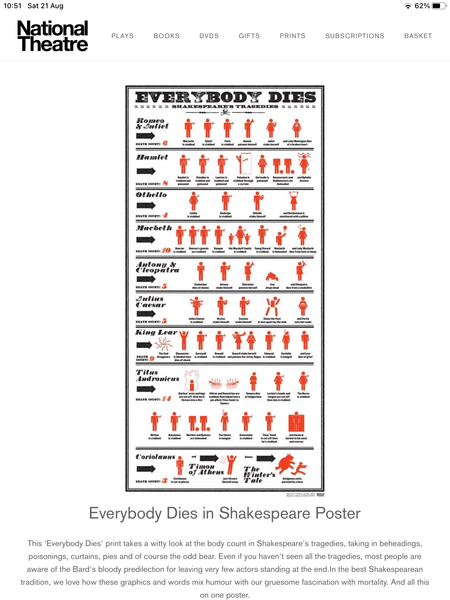
I hope this is legible - it’s a poster issued by the National Theatre to show how (gulp, hang on to your seats) - actually everybody dies in Shakespeare!
That's interesting, Devorgilla
From the sound of things they need to issue warnings about the experience, never mind the content of the plays?
I think they are warning tourists rather than those of us who know our Shakespeare. It's a 'must go to' venue for many. My daughter, living in London, attends the Globe very regularly, usually as a groundling. A groundling, for those not familiar with the term, is someone who pays to stand in the pit. She saw Titus Andronicus there and got covered in theatre blood. She knows to wear old clothes or have a waterproof covering. On that occasion 3 people fainted. The highest count, she believes, for Titus is 14 fainting. That creates problems for the staff who have to remove said person or at least make them comfortable. For anyone who has attended as a groundling you will know how space is limited. On her last visit, an American who had paid to be a groundling, argued with the attendant to show him where his spot to stand was and had great difficulty understanding it was a free for all. Regulars always get the best spot because they queue, English fashion, to be first admitted and then run. I think the warning is a case of 'If you can't stand the blood, stay out of the Globe'.
absent
I have my doubts about contemporary and non-Elizabethan or Jacobean versions of Shakespeare's play being "more relevant" to today's audiences. They belong to their time and present a snapshot of that time. A truly gifted, imaginative and creative director can transport the audience back in time enhance the essence of the author's vision for a modern audience.
I shall never forget the feeling of pure shock and comprehension when I saw Adrian Noble's production of Macbeth many years ago. In the scene with the witches following the banquet where Banquo's ghost appeared, the witches sat at the empty table and chewed on leftover bread, passing around the leftover wine. Right at the end, they spat it out and, even though I am an atheist, the shock of this deliberately blasphemous eucharist brought home to me something of what the original audience must have felt when they watched the play.
But isn't making plays 'relevant' what creative directors do all the time? I mentioned the Al Pacino Merchant of Venice upthread, for instance. It was set in the sixteenth century, and used language of the play, but was a modern take on the story. There are countless examples of other directors doing the same.
Many of the plays are set way before Shakespeare's time anyway - they were never intended as a portrayal of (his) contemporary life, but a way of using drama to comment on 'the human condition'. In many ways he was bringing old stories up to date by setting them in Elizabethan/Jacobean times.
I saw that production Katie59. It was indeed X rated but was more powerful in portraying the humiliation of the woman. Definitely not a comical version.
ginny
Oh my, are the going to change names in A Midsummer Nights Dream ?
eg. Bottom, Titania
They sound a bit rude and may offend.?
A year or two back the RSC did a modern version of Midsummer Nights Dream it was very bawdy, however it probably was very close to the original 16th century production.
It was NOT the version we did at school !.
M0nica
Read the small print at the bottom of the poster. It is a tongue-in-cheek send up of the modern obsession for warnings.
Not to be taken seriously. I thought fromt one of many of the above posts that it was a serious warning.
I thought that was obvious - but my apologies if it wasn’t legible enough. 
After a particular hectic week I have had a think and actually I quite fancy identifying as a bear from now on. But i think i would still like to identify as a female so a female bea. Just can't decide on honey or marmalade.
Read the small print at the bottom of the poster. It is a tongue-in-cheek send up of the modern obsession for warnings.
Not to be taken seriously. I thought fromt one of many of the above posts that it was a serious warning.
The teatowel is currently out of stock on Amazon. Drat!
It’s probably a good idea, given today’s blame and claim culture.
When we studied The MoV all those years ago we discussed the truth of the way Shylock was depicted and the history about moneylending around the 11th C. I don’t remember it being called anti-Semitism though.
The same idea occurs in Georgette Heyer’s The Grand Sophy.
MawBe I love your warning to ‘bears’ or those ‘identifying as bears’. Very current idea!
I have my doubts about contemporary and non-Elizabethan or Jacobean versions of Shakespeare's play being "more relevant" to today's audiences. They belong to their time and present a snapshot of that time. A truly gifted, imaginative and creative director can transport the audience back in time enhance the essence of the author's vision for a modern audience.
I shall never forget the feeling of pure shock and comprehension when I saw Adrian Noble's production of Macbeth many years ago. In the scene with the witches following the banquet where Banquo's ghost appeared, the witches sat at the empty table and chewed on leftover bread, passing around the leftover wine. Right at the end, they spat it out and, even though I am an atheist, the shock of this deliberately blasphemous eucharist brought home to me something of what the original audience must have felt when they watched the play.
Al Pacinos MoV is wonderful...just saying. I don't enjoy these statements after TV or cinema and now it's in the theatre. I will under how many of 'people affected' actually take up the suggestion and therefore is it worth saying?
I think there is a genuine issue with exposing dreamy teenagers to the idea that suicide for the sake of young love is somehow noble.
In my day, we studied R&J to the point of boredom before they took us to Stratford, and the slick rattled-off Shakespearean language and archaic costumes meant that most of us didn’t really engage with what was essentially ‘high culture”. More recent performances that try to engage with younger audiences and introduce elements of cultural relevance do risk prompting younger people to consider suicide as an appropriate response to a doomed love affair.
Portia may have been ahead of her time, but she was certainly racist: see her comments about the Prince of Morocco.
And MoV is certainly less antisemitic than Marlowe's Jew of Malta
I don't think anyone is suggesting that texts should not be studied, just that people seeing particular performances of theatre productions should have trigger warnings.
The question about whether outdated views in texts should be a barrier to their being on the curriculum is often debated. In my opinion there is no reason why they shouldn't be taught, along with discussions of the troubling issues. In fact, I think it would be worrying if children were only taught texts that fit the political views of the day (and it's debatable who would be best placed to decide on those). They need to be stretched and asked to consider different points of view, even if they are difficult ones. Also, looking at, say, racism through the lens of a book or drama can be a useful way of doing it, without the children feeling lectured or told what to think.
When it comes to productions, a decent director can tackle those issues head on. Look at the film production of The Merchant of Venice with Al Pacino. That looks at anti-semitism from Shylock's point of view. Plays are not stuck in their time - without changing the script they can be updated with clever casting, costumes, props and even meaningful pauses or glances after controversial speeches.
Isn't Romeo and Juliet on the GCSE English literature reading list?
Perhaps they should recommend some Mills & Boon instead!
Oliver Twist is a book - and while you can put whatever visual interpretation you want on a book character, he is very racially stereotyped. As are other characters in Dickens.
Oliver! is a 20th century musical and yes- the depiction of Fagin is pretty unacceptable by today’s standards.
Oh my, are the going to change names in A Midsummer Nights Dream ?
eg. Bottom, Titania
They sound a bit rude and may offend.?
good point mawbe but isnt that the same for say fagin in oliver who i believe is jewish
it has to be - trying to be delicate here - an ugly,mean sort of looking actor to fit the description of the character
“The Taming of the Shrew”
To be serious (for a moment) - the one play I find problematical is The Merchant of Venice.
Yes, I know it is of its time, but the blatant anti -Semitism, regularly reinforced by choosing an actor with (for want of a better word) “Jewish” facial characteristics , makes me very uncomfortable.
Shylock is very much wronged but is presented almost universally as a monstrous villain and someone deserving no pity.
However, on the subject of female equality Shakespeare gives us a shining example in Portia well ahead of her time.
(But don’t get me started on The Taming if the Shrew.)
Maw ?
Love the poster. Shows quite how ridiculous our snowflake society is becoming.
Warning-any bears or members of the audience identifying as bears in the audience should be aware that we are not anti- bear and recognise their ursine rights to pursue members of the cast stage right or indeed stage left”
Brilliant ??
For King Lear..... No eyeballs were removed in the making of this production.
I have slightly mixed feelings about this. I don’t know the full story of the content warnings for this version of R&J, but as a general principle I think they are over-used and pander to what can seem like a desire for everyone to be ‘protected’ against everything.
The theatre is supposed to stretch us - it was founded on notions of catharsis, so audiences could live through the adventures of the characters and ‘purge themselves’ of often difficult or violent emotions. If we sanitise everything this aspect of it all will be lost.
On the other hand, if someone is particularly sensitive to a particular 'thing', it makes sense for them to avoid it. I've always thought, for instance, that rather than age-related certificates on films there should be warnings to parents who can then decide on the suitability for their own children (and this applies to adults too), so that people can screen out things they don't want to see - even if it's a temporary measure whilst they are still grieving, or until they feel able to cope with whatever the situation is.
On the third hand ?, there are so many possible 'triggers' that it's reaching the point where you can't hear a poem read, or watch any form of entertainment without having to hear about the content in advance - it can spoil the experience before it starts.
I do like the poster, though - I'm tempted to send for a tea-towel.
Registering is free, easy, and means you can join the discussion, watch threads and lots more.
Register now »Already registered? Log in with:
Gransnet »Get our top conversations, latest advice, fantastic competitions, and more, straight to your inbox. Sign up to our daily newsletter here.