I would have thought such an exhibition ought to be something Hope not Hate should have in their sights to campaign against.
Good Morning Wednesday 26th August 2026


We've been down this road before with the so-called banker cartoons, distinct and insulting caricatures of Jewish men depicted getting rich with their feet on supposed ground down subjugated workers. Now here we are again, how is it even allowed? Jews, or Zionists if you prefer, are represented in the most racist and anti semitic way possible. For instance, the Jewish owner of Southeby's eating a baby, next to the words "Hey look I'm selling a fantastic painting while eating a baby alive"
At a time of a resurgence of unfettered prejudice against our Jewish community, always in the firing line and collectively targeted for all the ills the Israeli government has inflicted on Gaza, this timely exhibition, "Drawings Against Genocide" arrives at the gallery almost simultaneously with the Golders Green attack. Unbelievable hate filled tropes that have been passed down through history time again and again. Would it be tolerated against any other demographic? for example, different genocides, such as the one going on in Sudan, the rage level for those other atrocities where are they? and how would the supporters of this exhibition react if the perpetrators of similar acts of ethnic cleansing/genocide were cast in such a way to slur an entire race or ethnicity?
*Thread title edited by GNHQ to reflect the fact the exhibition is not at the Tate gallery*
I would have thought such an exhibition ought to be something Hope not Hate should have in their sights to campaign against.
Cumbrianmale56
Now imagine the uproar if the exhibition was one of Muslims planting bombs and chanting Alluha akbar. The artist would probably be prosecuted and the art gallery closed down. However, anti semitic art is OK, though, because everyone hates Istrael and Jews right, or probably so this warped artist thinks.
It sort of reminds me of the Jeremy Corbyn era when anti semitism became rife in the Labour Party, but because it came from the left, it was somehow OK.
Can I just say as a long term member of the Labour Party it was there from a certain group, but it absolutely certainly was not "rife".
That's actually a quite shocking allegation and everyone I knew in my branch stamped on any signs if for example a regime was conflated with a nation. Given that we had some Jewish members we were certainly strong and aware and against any such signs.
The art gallery in Margate is the Turner, not the Tate.
As a member of the Labour Pary for over 60 years can I just say antisemitism wa rife in the Corbyn years, corbyn was elected leader 2015, no matter this was known -
“Jeremy Corbyn has faced questions about a wreath-laying ceremony he attended in Tunisia in 2014.
The Labour leader has said he visited the cemetery to honour innocent people killed in a 1985 Israeli air strike.
But he has faced criticism because the event took place near memorials for people who were accused of having links to a terrorist attack at the 1972 Olympic Games”
I’m with Anniebach on this not Wyllow.
Once again Starmer reveals himself. Not only by who he protects but by who he stops protecting when the political cost rises.
Four ambulances burnt outside a synagogue on Monday and a UN position abandoned by him on Friday.
Should all Muslims be attacked for the horrors of 7th October 2023
Absolutely not, you are right Aniebach!
This is abhorrent. This exhibition should be shut down, the works by this "artist" burned and he should be charged with hate crime.
Matthew Collings, the artist behind an allegedly antisemitic art exhibition in Kent, has shared social media posts seemingly defending Hamas, appearing to deny or minimise the Holocaust, and suggesting the Hatzola ambulance arson attack was a false flag, the JC can reveal.
In October 2025, he reshared a post on X that said: “I don’t want peace with Israel, I want Israel gone. There is no peace with genocidal maniacs. No two-state solution. It’s one state, and it’s called Palestine. I am not a Hamas ‘apologist’, they have done nothing to apologise for.”
Jewish Chronicle.
The man is a disgrace and the police, who say the artwork is not insulting to Jews and does not meet the threshold for a hate crime need to think again. Which police officer decided that?
Kent Police should hang their heads in shame.
It is openly promoted as an "anti-semitic art exhibition".
I thought anti-semitism was against the law in the UK?
FriedGreenTomatoes2
Once again Starmer reveals himself. Not only by who he protects but by who he stops protecting when the political cost rises.
Four ambulances burnt outside a synagogue on Monday and a UN position abandoned by him on Friday.
How has Starmer protected the people who burnt the ambulances or this artist?
Incidentally, I think both are a disgrace, but I'm not sure how Starmer is implicated.
Indeed, twaddle - the exhibition should never ever have been allowed, and should be stopped, investigated as a hate crime, but as you say I totally fail to see how Starmer is "implicated".
How on earth is he supposed to know the exhibition was to take place?
I believe complaints were made to the police who refused to designate it a Hate Crime, but I may be wrong. I saw examples of some of the drawings in a newspaper and they were awful, both in content and presentation.
I wonder why Thanet was chosen by Collins as the venue for his antisemitism ? Doesn’t it have a history with the National Front?
To what extent therefore has the National Front infiltrated the decision making process in Thanet?
The fact that this disgusting exhibition is allowed is chilling.
The message this sends out is clear and is 'meat and drink' to the already unhinged.
This is in a private gallery and Thanet District Council will neither have been consulted, nor advised, of it's nature.
It would seem from what I have read, that this is a police matter, rather than a local authority issue
A district council has the powers to close a private art exhibition if it contravenes the law. So why hasn’t it?
ronib
I wonder why Thanet was chosen by Collins as the venue for his antisemitism ? Doesn’t it have a history with the National Front?
To what extent therefore has the National Front infiltrated the decision making process in Thanet?
The reason for that is probably because Tracey Emin lives in Margate and there's an arty community there.
ronib
I wonder why Thanet was chosen by Collins as the venue for his antisemitism ? Doesn’t it have a history with the National Front?
To what extent therefore has the National Front infiltrated the decision making process in Thanet?
I believe Thanet Council is a majority Labour one at present.
I didn't know that twaddle.
I do remember her saying, under the previous Labour government, that she was going to live in France because she was unwilling to pay 50% top rate of tax. France offered better tax advantages for artists.
Collings’ work reminds me of Max Beckman especially the latter’s Hölle Der Vögel (1937-38) (Bird’s Hell) which, nine years ago at Christie’s, sold for £36 million (it is believed to Jewish American billionaire financier Leon Black friend of Jeffrey Epstein).
Beckman originally called it The Country of the Insane as a reference to the brutality and popularity of the Nazi regime. There’s a lone, human figure being tortured in the foreground interpreted as the Nazi's assault on the rights of the individual and its use of political violence.
Hitler hated Expressionism and deemed it degenerate. Beckman’s work was confiscated; he had to flee Germany and never returned.
How does Beckman’s work differ from what Collings is trying to say about the brutality of Israel and its assault on the the people of Palestine (and now other parts of the Middle East)?
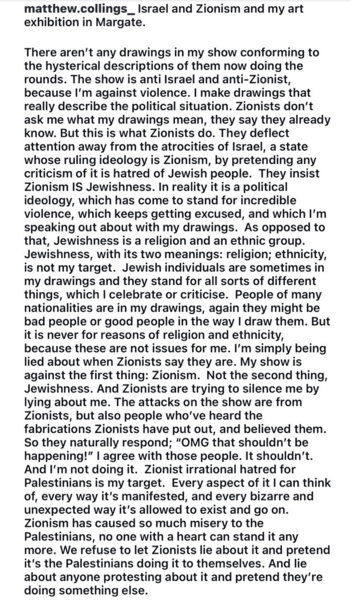
Collings makes it very clear (image attached) that he sees Zionism and the Jewish faith as two different things, which they are. He says: Zionist irrational hate for Palestinians is my target … Zionism has caused so much misery to the Palestinians that nobody with a heart can stand it any more. Do people condemning this exhibition disagree with that?
Collings has a right to criticise Israel’s belligerence under Netanyahu. Indeed there have been several threads here extremely critical of his actions and Trump’s support. How is that different?
Sometimes art is created deliberately to shock and generate debate. You might like to read this by Aaron Rosen, Professor of Religion & Visual Culture and Director of the Henry Luce III Center for the Arts & Religion at Wesley Theological Seminary, Washington, DC and Visiting Professor at King’s College London:
www.theguardian.com/artanddesign/2015/oct/23/offensive-art-holy-book-bomb-chocolate-jesus
www.kcl.ac.uk/people/aaron-rosen
Note what he says about Gregor Schneider’s work whose exhibitions were cancelled to avoid offending Muslims and as a security measure against terrorist retribution.
Whether Muslims really deem an artwork offensive often gets obscured by what non-Muslims think Muslims will feel. The potential threat posed by a tiny, yet flagrantly violent, minority dictates the discussion. It has become increasingly difficult (especially in the wake of the Charlie Hebdo attack) to discuss in any nuanced way if, how, and why certain images might be offensive to Muslims.
The idea of artists as iconoclasts on a quest to offend is compelling. Yet it tells only a fraction of the story. Art should challenge us. It should perforate our pieties, religious or otherwise … The people who need it to be offensive are the ideologues, who may never set foot in a gallery.
It seems to me that outrage is being shown in some parts of the media and here without seeking to understand what Collings is saying about war and genocide - not so different to Beckman or indeed Picasso’s depiction of the bombing of Guernica by Nazi Germany and Fascist Italy and Dumile Feni's African Guernica about living under apartheid, also now on display at the Reina Sofia in Madrid.
I imagine I will be flamed for this but I am simply trying to put the work into perspective.
Graphite but is it for Collings to say that there should only be Palestine and Israel should not exist?
I stand corrected, as pointed out up -thread, it's the Turner Gallery not the Tate, I think I'd conflated it's modern edifice in mixing it up with the Tate. Yes! Tracy Emin lives in Margate and has had much to do with establishing an art community in that town which has drawn some of the newer residents out of London. Good train links back into London I'm told
Graphite I'm not going to flame you as I was looking up Collings work as a whole
Becuase we are talking about just 1 to 3 images from an exhibition out of context and not from Collings whole body of work(but crucially what I couldn't find, I don't think it exists) the breadth of images in the exhibition. I think the points you make are valid
"without seeking to understand what Collings is saying about war and genocide"...And the police having viewed it, find the same?
Without seeing it as a whole and read everything I can I genuinely do not now know whether it should be shot down in flames or perhaps whether some work should be removed
Most of his work is like this www.schoolgallery.co.uk/matthew-collings-available-works
Allira
^Matthew Collings, the artist behind an allegedly antisemitic art exhibition in Kent, has shared social media posts seemingly defending Hamas, appearing to deny or minimise the Holocaust, and suggesting the Hatzola ambulance arson attack was a false flag, the JC can reveal.^
In October 2025, he reshared a post on X that said: “I don’t want peace with Israel, I want Israel gone. There is no peace with genocidal maniacs. No two-state solution. It’s one state, and it’s called Palestine. I am not a Hamas ‘apologist’, they have done nothing to apologise for.”
Jewish Chronicle.
The man is a disgrace and the police, who say the artwork is not insulting to Jews and does not meet the threshold for a hate crime need to think again. Which police officer decided that?
How about this Graphite?
“Hamas have done nothing to apologise for” !
Despite any mealy mouthed words from the artist about separating Israelis and Jews from Zionism it’s quite obvious that he doesn’t.
The police should seek guidance if they don’t see it as a hate crime.Far lesser things have a couple of burly cops on your doorstep! Saying something is merely Art when there’s such an agenda behind it is absolute rubbish.
Registering is free, easy, and means you can join the discussion, watch threads and lots more.
Register now »Already registered? Log in with:
Gransnet »Get our top conversations, latest advice, fantastic competitions, and more, straight to your inbox. Sign up to our daily newsletter here.