

I agree Oreo, including the keeping of any livestock (animals and birds) in ‘food production’.
Gransnet forums
News & politics
A growing population in the UK but we have to lose 10% of farmland.
(107 Posts)The Labour government are beyond belief.
How are we going to feed a growing population if we have to reduce productive farmland by 10%?
Is there something I am missing?
The O/P appears to have come out of a DM article today which when you read the detail you realise isnt at all what the O/P claims.
www.dailymail.co.uk/news/article-14344721/british-farmland-threat-net-zero-labour-plans.html
The 10% includes land already used for non food production use and the whole ranch of suggestions are for discussion not legislation.
Th article suggests for example by showing pictures of farmers demonstrations its opposed by all farmers, but as I found and quoted above many famers have benefitted by giving over a small amount of their land - they can choose the non productive or low productive bits - to wilding or solar panels to make up a viable income.
is there something I am missing?
Yes
Accuracy.
Barleyfields
I agree Oreo, including the keeping of any livestock (animals and birds) in ‘food production’.
Yes, I forgot about mentioning the livestock.Sheep can live on very difficult ground.
I simply don't understand why all new homes being aren't fitted with solar panels.And all the massive warehouses and distribution centres I see alongside our motorways.So many other areas rather than what should be productive farmland.
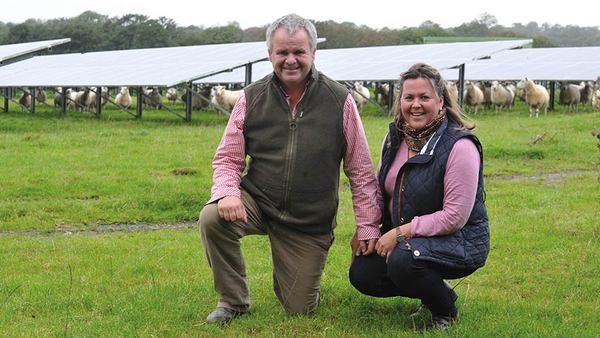
In farmers weekly, farm with sheep and solar panels.
Sheep and solar panels do not increase biodiversity.
GrannyGravy13
MaizieD I assumed that if EM was championing this he would have publicised it.
I only ever hear him championing carbon capture (someone should take him aside and say that’s what trees have been doing for millennia)
Peat bogs, seagrass meadows, grass, soil itself as well as forests are all important for carbon capture.
There are protests in the Cotswolds, where 2,000 acres of agricultural land is to be turned over to solar panels.
Who would own that land? A huge conglomerate, individual farmers, the Government? Who decides if it can be used for agriculture?
Can it be farmed on? With difficulty, surely?
Wyllow's picture shows a couple of people hand picking produce. That form of farming will not feed 70 million people.
Washerwoman
I simply don't understand why all new homes being aren't fitted with solar panels.And all the massive warehouses and distribution centres I see alongside our motorways.So many other areas rather than what should be productive farmland.
Me neither.
It makes more sense, surely?
Wyllow's picture shows a couple of people hand picking produce. That form of farming will not feed 70 million people.
Which picture was that, Allira?.
I only saw the one of the couple posing in front of their sheep and solar panels.
Allira
Washerwoman
I simply don't understand why all new homes being aren't fitted with solar panels.And all the massive warehouses and distribution centres I see alongside our motorways.So many other areas rather than what should be productive farmland.
Me neither.
It makes more sense, surely?
I don't understand it, either. Perhaps the conventional energy companies don't like the idea as it will adversely affect their sales.
Sorry, I've found the picture now, it was posted much earlier.
I very much doubt that an operation of that size would solely depend on two people to harvest the crop... 
But that's another area where we need to be looking at mechanical harvesting instead of importing short term (but highly skilled) foreign workers to harvest our produce.
There must be a whole growth industry right there in mechanisation and one which wouldn't cause a loss of jobs for the British (because they don't like harvesting jobs anyway and won't do them)
Wyllow3
David49
It’s a lot more than 10% of farmland being lost currently more like 25%+ and what there is yielding less because of regulations restricting inputs. Whole estates, several thousand acres are being taken out of food production
We are heading for shortages, a sensible government would reverse many of the restrictions the Tories brought in, whether Labour does that remains to be seen.I genuinely don't know what restrictions you mean currently in operation, David?
Many chemicals have been banned causing crop failures, and reduced yields, fertilizers previously used to increase yields are now restricted - the government now micro regulates exactly how much can be applied to crops.
Most farmers are well diversified and food production has become the minor source of income, in a great many cases, they can put the land in various environmental schemes, rent some neighbours and maintain decent income.
The neighbouring 3000 acre estate sold all the farm machinery in September and put the whole lot into environmental. No fall in income the only change is no food production, on a smaller scale many farmers are doing the same.
The government is claiming the are investing over £2bn a yr in farming the highest ever, ignoring the fact that before Brexit the EU was investing far more
David49
It’s a lot more than 10% of farmland being lost currently more like 25%+ and what there is yielding less because of regulations restricting inputs. Whole estates, several thousand acres are being taken out of food production
We are heading for shortages, a sensible government would reverse many of the restrictions the Tories brought in, whether Labour does that remains to be seen.
what is the source for this information?
Not all farmland is top quality land and less productiv land can be returned to woodland.
Humans get more from land besides food. We need woodland and wild areas to absorb carbondioxide and to enable biodiversity. Only look back 30 years, and the number of birds and insects in our gardens, or that you wll see on walks in the countryside has shrunk. These are all part of the natural world that gives us the insects that pollinate our crops and the birds that eat more harmful insects. I haven't heard a full throated dawn chorus for decades - and I live in a rural area.
The one thing that worries me, is that when ministers talk about making farmland more productive. I am concerned about the use of pesticides, herbicides, and a move to intensive animal rearing systems like those in the USA.
Where we live in the last two years nearly two thousand homes have been built taking up farm land. The housing being built is private so it is not social housing for rent which we are told is in short supply.
Most of the land was arable for crops fruit farms and rapeseed. It remains to be seen how we are going to be less dependant on imports from elsewhere and the urban sprawl continues.
The one thing that worries me, is that when ministers talk about making farmland more productive. I am concerned about the use of pesticides, herbicides, and a move to intensive animal rearing systems like those in the USA.
I consulted Chatgtp, an AI programme. I asked it about sustainable intensive farming. It came back to me (within seconds) with this (sorry, it’s long)
Start
Sustainable intensive agriculture in the UK refers to practices that aim to increase farm productivity while reducing environmental impact, improving biodiversity, and maintaining long-term soil health. Given the pressures of feeding a growing population and the need to reduce carbon emissions, the concept seeks to strike a balance between efficiency and ecological responsibility.
Some key strategies for sustainable intensive agriculture in the UK include:
Agroecological Practices: This involves using farming methods that work with nature, such as crop rotation, intercropping, and the integration of livestock and arable farming. These practices can help maintain soil health, increase biodiversity, and reduce the reliance on synthetic fertilisers and pesticides.
Precision Farming: Using technology like GPS and sensors to apply water, fertilisers, and pesticides more precisely. This reduces waste and lowers environmental impacts, as inputs are used more efficiently and only when necessary.
Integrated Pest Management (IPM): This approach reduces the need for chemical pesticides by encouraging natural pest predators, using resistant crop varieties, and applying targeted interventions only when necessary. This helps to preserve beneficial insects and ecosystems.
Cover Cropping and No-Till Farming: These methods help prevent soil erosion, improve soil structure, and increase organic matter. Cover crops also capture excess nutrients, preventing them from leaching into waterways.
Renewable Energy: Incorporating renewable energy sources, such as solar panels or wind turbines, on farms can reduce the carbon footprint of intensive agricultural operations and make farming more energy self-sufficient.
Water Management: Improving irrigation systems and collecting rainwater can reduce water usage, an important consideration given the UK's variable rainfall patterns and the increasing threat of droughts.
Farm Diversification: Integrating diverse crops and farm enterprises (such as agroforestry or bioenergy) can reduce reliance on monocultures, making farms more resilient to climate change and market fluctuations.
The UK government has been promoting sustainable farming practices through schemes like the Environmental Land Management (ELM) programme, which incentivises farmers to adopt eco-friendly practices. However, challenges such as balancing productivity with sustainability, the cost of transition, and market pressures continue to shape the landscape of UK agriculture.
End
I wouldn’t do this normally but I thought posters might be interested in possible directions that the farming industry are taking to improve food production.
Others with practical knowledge might well take issue with some, or all of these initiatives.
I think we might live in a similar area Redhead56 Local farmers used to grow rape but were getting poor yields because of pests (neonicitinoids that were used to control have been subject to bans) and orchards have been ripped up because there's no one to pick the fruit, some of that land has been used for housing. We are rural but with easy access to a motorway which gives fast access to three cities. We've had the same number of new houses built with social housing built into the planning application. The problem there seems to be is that housing associations haven't had the money to buy the houses from the builder, we've got plenty of need for social housing but there's not been the funding to support it.
mum2three
Perhaps I have a problem with my memory but I don't recall being asked how I felt about having thousands of immigrants coming into this country. Was it actually on Tony Blair's manifesto?
Horrible comment and without our migrants many services and industries would simply not work.
We’ve had migrants since the day dot!
My husband is a migrant from S. Ireland, came here at 5, with his family as his Dad helped build roads, he then became a bus driver, took himself off to evening classes, ended up studying at The London School of Economics and then took a very senior role as a Union Rep, travelling to Brussels to help set up new employments rights.
When I worked in the City, late seventies to late eighties, almost every menial paid employment was undertaken by migrants.
During various hospital stays, many staff were migrants, in my MiL’s residential care home at least 50% of the workers are migrants.
What is it you don’t understand about our migrant population here, most of whom work very hard and pay their dues?
I do hope you only buy British, eat only English food, drive a British car (is there one anymore?) and don’t holiday outside of the UK!
I simply don’t understand why all new homes aren’t being fitted with solar panels
Probably because many properties just aren’t suitable for them.
We had solar panels installed about 10 years ago. The installer said our property was ideal i.e.
The roof faced south.
It had just the right ‘pitch’, (important)
It had no trees, buildings, obstructions in the way.
We have been well pleased with them, so glad we had it done, but made me realise that many other properties just aren’t suitable.
I take note as I pass other houses and think, ‘faces wrong way’, ‘too near those trees’ etc.
New housing estates don't have any mature trees to interfere with the operation of solar panels. They're just a sea of roofs 
Builders surely must be able to find a suitable aspect on most of those roofs?
MaizieD
New housing estates don't have any mature trees to interfere with the operation of solar panels. They're just a sea of roofs
Builders surely must be able to find a suitable aspect on most of those roofs?
No, although we our roof faces east/west apparently it wouldn't be suitable.
Don't builders have to plant trees as part of landscaping?
The 2021 ‘National Planning Policy Framework’ (NPPF) states: ‘Planning policies and decisions should ensure that new streets are tree-lined and that opportunities are taken to incorporate trees elsewhere in developments’.
Existing trees may have preservation orders.
Allira
MaizieD
New housing estates don't have any mature trees to interfere with the operation of solar panels. They're just a sea of roofs
Builders surely must be able to find a suitable aspect on most of those roofs?No, although we our roof faces east/west apparently it wouldn't be suitable.
Don't builders have to plant trees as part of landscaping?
The 2021 ‘National Planning Policy Framework’ (NPPF) states: ‘Planning policies and decisions should ensure that new streets are tree-lined and that opportunities are taken to incorporate trees elsewhere in developments’.
Existing trees may have preservation orders.
The trees that might be specified for landscaping (though I can't say I've noticed any at all being planted on new estates round our way) will generally be ornamentals that don't grow so high as to overshadow roofs (apart from bungalow roofs) and don't have root systems that could attack foundations.
Trees with TPOs can be 'accidentally' badly damaged or removed...
Surely a positive approach to this is needed, not spurious attempts to wriggle out of it?
Likewise, some positivity with regard to agricultural practices is needed, but I note that there's no interest in looking at developments...
Well I was interested in your list of developments in farming.
Quite a lot of them are a new take on what farmers used to do in the days of family farming like water conservation or crop rotation.
Can we change buying expectation? Think how cheaply those bags of ‘wonky carrots” are sold. Not enough to pay for growing them but perfect ones are hard to come by without intensive methods.
Can we change deeply held beliefs. A farmer near us wh introduced a small cattle herd to increase bio-diversity and soil health was targeted by a group who saw it as a backwards step from his totally arable farm.
Another farmer who dug ponds for water retention was ordered to fill them in because they affected the water flow into a local reservoir.
It’s all so much more complicated than it appears.
Wyllow3
The O/P appears to have come out of a DM article today which when you read the detail you realise isnt at all what the O/P claims.
www.dailymail.co.uk/news/article-14344721/british-farmland-threat-net-zero-labour-plans.html
The 10% includes land already used for non food production use and the whole ranch of suggestions are for discussion not legislation.
The OP read this in the Telegraph not the DM.
Join the conversation
Registering is free, easy, and means you can join the discussion, watch threads and lots more.
Register now »Already registered? Log in with:
Gransnet »