👋👋👋
Good Morning Wednesday 1st July 2026
Giorgia Meloni Gives Trump Both Barrels!


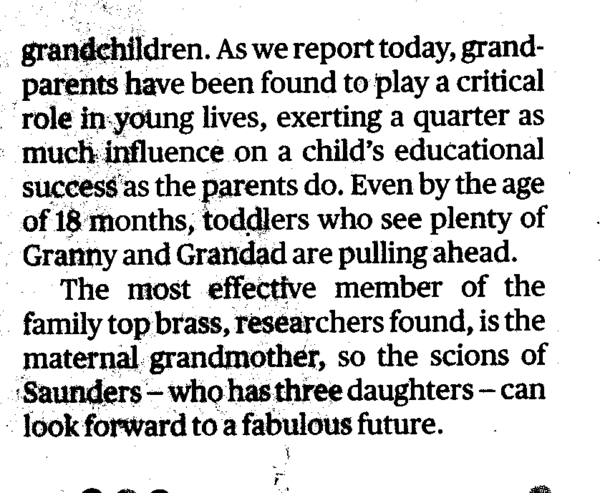
Spotted in an editorial in the Sunday Times 24 May 2026: "Grandparents have been found to play a critical role in young lives, exerting a quarter as much influence on a child's educational success as the parents do. Even by the age of 18 months, toddlers who see plenty of Granny and Grandad are pulling ahead."
The trigger for this editorial came from two news items: one about Jennifer Saunders' new status as a celebrity supergran, and one about a recent report published by the Social Mobility Commission entitled "The Role of Families in the Educational Outcomes of Children and Young People."
Neither of these news items specifically mentioned estrangement but the implications are clear: EAC who prevent contact between their children and grandparents for no good reason are doing their children a disservice.
For copyright reasons I can only reproduce an short extract from the editorial here, but you can find the originals at:
www.thetimes.com/life-style/celebrity/article/jennifer-saunders-absolutely-fabulous-interview-tv67twqqm
www.thetimes.com/comment/the-times-view/article/jennifer-saunders-vegetable-patch-grandchildren-grandparents-hmq90kbm5
socialmobility.independent-commission.uk/publication/the-role-of-families-in-the-educational-outcomes-of-children-and-young-people/
The two Times articles are behind a small paywall; the Social Mobility Commission report is free.
👋👋👋
impact is more important than intent no it isn't because intent can make the impact more painful, not physically if the the act is a physical one, but emotionally if the intent of the physical act was only to inflict pain for the pleasure of the one doing so.
How does this differ from a thread I started earlier quoting the self-same article?
Quote MawsRosie Sun 24-May-26 10:45:24
In today’s Sunday Times (not that it comes as news to any of US)
Research suggests they're even more important than you thought
It is said that it takes a village to raise a child — and the key is to have supportive grandparents.
A government-funded report will say this week that grandparents who spend time with their grandchildren play a critical role in their future success
The Social Mobility Commission analysed academic research to determine which parts of children's family lives had the greatest influence in determining positive life outcomes, including academic success
The “grandparent effect” was strongest for the mother's mother
Nice to get some recognition at last!
(goes off to polish halo 😇😇😇😇😇😇 )
#supergransRus
Because impact is more important than intent. Decades ago, parents were advised that physical punishment was necessary to raise children well. I don't think parents should be blamed for following the advise at the time, but they are still accountable for the damage physical punishment caused. Not being aware of the harm does not mean the one who caused it is not responsible.
bakestrategic
Are you saying parents shouldn't have to be accountable for the unavoidable ways they fail their children?
Actually yes I am saying that. If those ways have been unavoidable or inevitable why should they be accountable?
How about mature adult children showing some tolerance towards to their parents?
When people decide to have children they have no idea how that will pan out. Any number of unforeseeable situations could arise afterwards which impact on the relationship - in a positive or a negative way.
Most children grow up and recognise that.
Perhaps "inevitable" is a better word than "unavoidable."
Are you saying parents shouldn't have to be accountable for the unavoidable ways they fail their children?
bakestrategic
I think people shouldn't have children if they can't accept that they will fail them and will need to be accountable for those failures. And unfortunately I think the majority of parents don't anticipate this fact or accept it.
Going by your theory it's amazing the human race didn't die out centuries ago
eddiecat78
There are so many holes in your argument that I don't know where to start. And I doubt you are open to consider any other opinions anyway, so I'll keep quiet
I'm open to facts and other verifiable evidence.
I think people shouldn't have children if they can't accept that they will fail them and will need to be accountable for those failures. And unfortunately I think the majority of parents don't anticipate this fact or accept it.
In that case, then, none of us should have children?
I mean any of us, across all age ranges, from those who are grandparents now, to those who are in their mid forties and are still failing to provide what's needed for their children.
There are so many holes in your argument that I don't know where to start. And I doubt you are open to consider any other opinions anyway, so I'll keep quiet
Ok. My point is parents in general seem to over estimate they're parenting skills and how well they met their children's needs. I think people in general underestimate the harm they caused their children while raising them, and acknowledging it would be too painful. It's inevitable that parents will harm their children to some extent while raising them despite best efforts. That doesn't mean the harm is acceptable, and saying "I tried my best" "I'm not perfect" minimizes the previous harm and causes further harm in the present. I think that's a big facet in this multifaceted phenomenon.
Yes, I'd think so.
Could the same be said for estranged adult children who come onto this site and post lies about members?
Would they seem like fulfilled, healed, happy people?
Its so multifaceted.
Could the same be said about parents who shared their feuds on this site?
I'd say its its abusive to share it on Reddit.
Presumably the parents they've cut out of their lives haven't been consulted, and wouldn't agree to having their family feud posted online.
The article DogWhisper posted is about children, under 18. That is not relevant to estrangement outside of perhaps instances when the children grow up to become murderers or something. The behavior of estranged children described on reddit isn't emotional abuse unless it's intentionally being shared with the parents involved. "Harm," "children," and "power" all have established definitions.
Parents don't have all the power over their children when they become adults and as estrangement between parents and their children only occurs when the children are adults, this is of course relevant.
Why would the rate of harm parents cause their children be equal when parents have all the power over their children?
Again, it all depends on what you mean by "harm", what you mean by "children" and what you mean by "power". Estranged adult children do enormous emotional harm to their parents, by the fact of the estrangement itself, and by some of the abusive behaviours subsequently perpetrated by the children. Example: getting their parents to repeatedly apologise to them by text and then screenshotting the apologies and posting them on social media for the purpose of entertainment and humiliation - regrettably a common sight on Reddit. These actions are justified by slogans such as "We didn't ask to be born, therefore we don't owe our parents anything" which are common currency on estranged children's forums. By any definition, this is emotional abuse.
Discussion about emotional abuse almost always focuses on actions by the parents, hardly ever on actions by the children. I'm simply trying to redress the balance.
No, I wouldn't say that, and the article you posted doesn't say that either, it doesn't say what the rate of children harming their parents is and it has a lot of limitations such as small sample sizes. I'm also not sure what relevance the article has to estrangement. I think it goes without saying that adults harm children at much higher rates than children harm adults. Why would the rate of harm parents cause their children be equal when parents have all the power over their children?
around 1/3 of parents emotionally abuse/neglect their children
OK. And by the same token, would you say that 1/3 of children emotionally abuse / neglect their parents? It really all depends on what you define as "emotional abuse". And in case you think that child-to-parent abuse isn't a thing...
pmc.ncbi.nlm.nih.gov/articles/PMC11370202/
Yeah I'm thinking it's a societal/cultural thing more than a generational thing but I'm trying to learn more.
So the parents of teens are most likely in their 40s, I reckon.
There or thereabouts
I've noticed many people have a "heroes all" attitude towards parents. That all, or most parents are "heroes" - good and loving parents. I think the assumption that most parents are "good" is unfortunately likely not the case. For example, this article about teens in the US says that only 58.5% of teens always or usually have their emotional/social needs met, however 93.1% of parents say their teens' emotional/social needs are met: www.apa.org/monitor/2025/04-05/teen-social-emotional-support
It seems to me that since over the past few decades corporal punishment/physical abuse has become less socially acceptable (for good reason in my opinion as research shows it's ineffective and harmful long term) more focus has gone to emotional abuse/neglect. I suspect that since many older people were raised when physical and emotional abuse were more normalized, they may feel that since they weren't physically abusive like their parents were, their children complaining about emotional needs is unfair since they dealt with it as kids, so their children just need to "toughen up" or "get over it." Thus, generational trauma is passed down.
However, emotional abuse is in fact physical abuse, especially to children. It alters the way a growing brain develops and can even cause brain damage over time. Some people think emotional abuse is worse than traditional physical abuse because emotional abuse is much harder to identify, prove, and heal from. Another study says that about 36% of adults report experiencing childhood emotional abuse. The actual percentage could be higher or lower.
pmc.ncbi.nlm.nih.gov/articles/PMC7589986/
With this in mind, I'd hazard a guess that around 1/3 of parents emotionally abuse/neglect their children, and most probably are not aware of it. And that is just one kind of abuse children might face. Parents also don't necessarily have to be abusive to not meet their child's needs as well.
As science reveals more understanding of childhood development, it might seem like the bar for "good" parenting is constantly rising. Isn't that a good thing though? Don't we want higher standards for the treatment of the most vulnerable? I suppose my point is it seems to me that a lot of the conflict between some EPs and ECs is rooted in issues stemming from emotional abuse/neglect. I'm not accusing any poster of anything, just pointing out some facts and how different generations view emotional wellbeing.
It is, I'm sure.
I've even seen people return in a variety of usernames, just to have a go at estranged parents.
Imagine that!!
Registering is free, easy, and means you can join the discussion, watch threads and lots more.
Register now »Already registered? Log in with:
Gransnet »Get our top conversations, latest advice, fantastic competitions, and more, straight to your inbox. Sign up to our daily newsletter here.