

Whilst ultimately it is the children themselves who initiate their friendships one can foster and encourage the development of new relationships by inviting friends round to play, encouraging them in joint games and activities. Many childrens' games have been played at my table with both Nanny and Grandad involved and I would say many of those children who played are still great friends of my grandchildren.
Gransnet forums
Competitions
Win a Mini Microscooter plus a bundle of Alfie books
(163 Posts)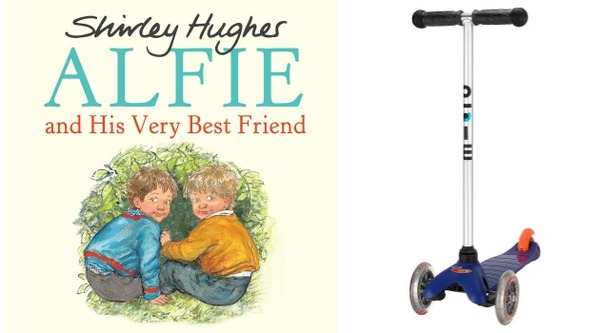
To celebrate the publication of Alfie and His Very Best Friend, we're giving away a blue Mini Microscooter plus a bundle of Alfie books, including the latest book.
Alfie and Bernard are very best friends and together they have lots of adventures. Join them as they go to the library, take part in scooter races and make a very special club with only two special members! A heart-warming tale of friendship by the award-winning Shirley Hughes, creator of Dogger.
Shirley Hughes has won the Other Award, the Eleanor Farjeon Award, and the Kate Greenaway Medal for Illustration twice, for Dogger in 1977 and for Ella's Big Chance in 2003. In 2007 Dogger was voted the public's favourite Greenaway winner of all time. Shirley received an OBE in 1999 for services to Children's Literature, and is the first recipient of Booktrust's Lifetime Achievement Award.
To be in with a chance to win a blue Mini Microscooter and a bundle of Alfie books including Alfie and His Very Best Friend, tell us what are your top tips for helping your grandchild to make friends?
Post your entry below by midday Wednesday 12 October. Can't wait? You can purchase your copy of Alfie and His Very Best Friend on Amazon.
Usual T&Cs apply.
From my experiences with my 3 children you can't enforce friendships - but you can encourage children to be sociable. Visiting places or attending groups and activities where children are encouraged to mix is great. My sons are both very confident in making new friends, but my daughter not so much. I think the key is involving them in activities that they enjoy where they might meet likeminded people so they already have a mutual interest. Also activities with other families where children will mix. Children will learn from your examples - so if you are friendly and open to making friends in unfamiliar situations then hopefully your children will follow suit. Having different groups of friends in different areas is always a good thing, especially as children get older and arguments start and/or friendships change. Show children the importance of friends (after all friends are the family you choose). Make them aware that not all friendships are lifelong and that some friends are only in your life for a short time, some come and go, and some will be there for the long haul!
don't hide them away mix with people and kids
Honestly, just let them get on with making their own friends! Give them the opportunity to mix with other children, parks, play groups etc, they will work it out!
Pre school and nursery are a good place to start, also playgrounds and recreational areas.
When i was growing up we used to play outside and made friends with the other children on the street. How sad that this rarely happens these days.
By example....if you are friendly, sociable and outgoing then littlies will generally tend to copy you. Being involved socially with other families is so good for them, they can meet and play with friends but still have the security of mum/dad being close by. As they mature they will move away from needing familiar adults. Play dates with known friends are also fab especially if mum can leave them for short periods thus fostering their independence. These will also lead them into meeting different groups of friends. Lots of different cogs overlapping! Slightly older children benefit from groups and clubs-sports or activity based with invites to these new friends to come and play at the child's home.
Given lots of opportunity to socialise but also making sure that they respect others and don't expect their own way all the time. Teaching them empathy will help them be good friends to others and hopefully others will then want to be friends with them.
By taking them regularly to parent and toddler groups from young they (eventually) learn to play nicely with other kids, share toys, even watch others behaviours (not always the best but still useful), eat/drink with others and go onto have play dates with new friends (parents too ;) ) This is invaluable and friendships made there can last until adulthood as they practice again and again the skills they learnt as soon as they could sit up!
I advise my eight young grandchildren to be interested in other people, not just in themselves...listening to others is an important skill - also, to SMILE at other children and to try to be kind...include children who seem to be lonely or are being left out. At the same time I also add that they need to be firm and not let people take advantage of them - no-one wants to be friends with a doormat!
Children learn to behave by how those around them behave so set a good example and encourage kind behaviour. My four year old grand daughter is only given a few jelly babies as an occasional treat, she offered one to her Grandad and he was going to say no but I said she is learning to share so take one and say Thank you. She is very caring when someone is hurt or upset.
give the opportunity to mix and play as much as possible and encourage communication
The children need to have a variety of experiences from a young age. Playing with them helps to develop their understanding of fair play and give and take which are important aspects of friendship. I believe that it is vital to talk to children widely, to set boundaries and that they understand what and why these are there, talk to them about friends...all the ins and outs, offer sage advice on how to deal with situations.Use pets to help them develop tolerance and kindness. Above all love them unequivocally. Be a positive role model that they can copy and emulate. Help them to develop the self confidence to be their own person. All this will help them to fall happily into a variety of friendships.
Teaching them that they must share and think of other people. This may be difficult as children do tend to be self centred but they can learn.
Read a book together and ask both children questions about the pictures.
Tell child to go up to other child and say Hello, what's your name?
Invent a story in the playground and get another child to join in e.g we go to Mouseland, let's find Minnie
I set up play dates with children similar ages, go to places where children are. I show my DS me chatting and being friendly and saying hello etc
Take them to places where there are other kids their age and tell them how fabulous they are so why wouldn't other kids wouldnt want to be their friends
Teach them to listen to others, as well as to speak; give as well as take; be fun and enthusiastic; be non-judgemental and open to new ideas and start new conversations with a question and a smile.
When our GC visit we get them involved with our neighbouring children by organising games such as "what's the Time Mr wolf", " hide and seek", where they all join in, the children then become familiar and are welcome in their own games.
Have an open house policy. When my granddaughter plays outside the front door is left open. Neighbourhood children wander in and out at will. Granddaughter runs in and gets a bunch of ice lollies out of the freezer and shares them around.
If you teach them to treat others as they expect to be treated, they can't go wrong. My parents and grandparents didn't do anything to help me make friends leave it to them, unless you see a problem.
I think it is important to try to instil and measure of self-confidence into children but also to make them aware that it's ok to be different and that not everyone is the same.
Give them a chance to meet other children. Soft play, parks etc
Encourage your grandchild to make friends by being friendly yourself. With a good role model and opportunities for play dates at your home and theirs, making friends will be a natural part of growing up for your grandchild.
give them plenty of opportuinites to mix with other children
Have simple conversation with them to teach them small talk! , like 'Hello ...., How are you today? I like your t-shirt, do you like my t-shirt? Shall we play paw patrol?'
Join the conversation
Registering is free, easy, and means you can join the discussion, watch threads and lots more.
Register now »Already registered? Log in with:
Gransnet »